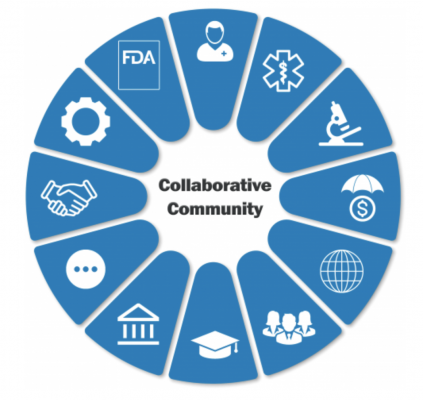
August 4, 2021 — The U.S. Food and Drug Administration announced participation in several new collaborative communities aimed at addressing challenges in patient healthcare. Collaborative communities are a continuing forum where private and public sector representatives of the community work together on medical device challenges to achieve common objectives and outcomes.
“We’re pleased to announce the progress we’ve made with participation in collaborative communities. These collaborations with diverse stakeholders are not only a strategic priority for the FDA’s Center for Devices and Radiological Health, they also provide much needed forums for deep discussion and solution-driven initiatives to tackle important issues within the medical device ecosystem,” said Jeff Shuren, M.D., J.D., director of the FDA’s Center for Devices and Radiological Health. “The insights and outcomes developed by these groups will have long-standing impacts on public health.”
The FDA currently participates in 12 collaborative communities, which are established, managed and controlled by external stakeholders. Collectively these communities are charting paths to accelerate and address regulatory science and other knowledge gaps to aid in medical device review and oversight. They may also impact the delivery of healthcare and change clinical care paradigms.
The most recent collaborations focus on topics such as: medical device development and product quality; understanding of valvular heart disease; innovations in digital pathology; reducing rates of intended self-injury and suicidal acts by people with diabetes; and strategies to increase the awareness, understanding and participation of racial and ethnic minorities in the medical technology industry. The FDA participates in these collaborative communities:
- Collaborative Community on Ophthalmic Imaging
- National Evaluation System for health Technology Coordinating Center (NESTcc) Collaborative Community
- Standardizing Laboratory Practices in Pharmacogenomics Initiative (STRIPE) Collaborative Community
- International Liquid Biopsy Standardization Alliance (ILSA)
- Xavier Artificial Intelligence (AI) World Consortium
- Case for Quality Collaborative Community
- Heart Valve Collaboratory (HVC)
- Wound Care Collaborative Community
- Pathology Innovation Collaborative Community (PICC)
- REducing SuiCide Rates Amongst IndividUals with DiabEtes (RESCUE) Collaborative Community
- MedTech Color Collaborative Community on Diversity and Inclusion in Medical Device Product Development and Clinical Research (MedTech Color Collaborative Community)
- Digital Health Measurement Collaborative Community (DATAcc)
“The number of collaborative communities has continued to grow, showing that, amidst the backdrop of the COVID-19 pandemic, many remain dedicated to the idea that together, they can better achieve common outcomes, solve shared challenges and leverage collective opportunities to improve public health,” said Michelle Tarver, M.D., Ph.D., deputy director of the Office of Strategic Partnerships and Technology Innovation in the FDA’s Center for Devices and Radiological Health.
Collaborative communities are convened by interested stakeholders and may exist indefinitely, produce deliverables as needed and tackle challenges with broad impacts. The FDA does not establish, lead or operate collaborative communities, nor are collaborative communities intended to advise the FDA. Instead, the FDA may participate in the community in order to contribute its knowledge and perspective to discussions of public health challenges and solutions.
The FDA reached the goal set as part of CDRH’s 2018-2020 Strategic Priorities of participating in at least 10 new collaborative communities by December 31, 2020.
For more information: www.fda.gov
 October 23, 2026