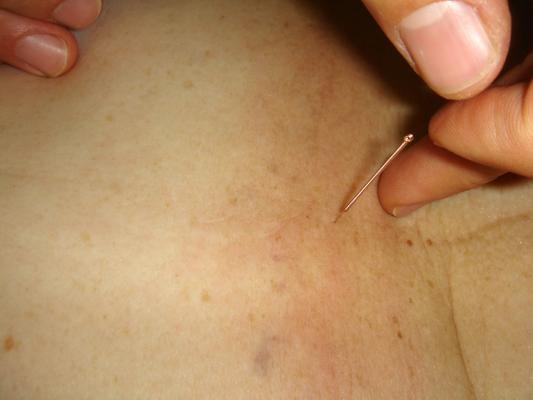
Image by Rudolf Langer from Pixabay
December 6, 2019 — After receiving acupuncture treatment three days a week during the course of radiation treatment, head and neck cancer patients experienced less dry mouth, according to study results from researchers at The University of Texas MD Anderson Cancer Center.
The trial results, published in JAMA Network Open, is the first randomized, placebo-controlled, Phase III trial to evaluate the use of acupuncture during radiation therapy to reduce the incidence and severity of radiation-induced xerostomia, or dry mouth. Acupuncture treatment has very few side effects and is relatively low cost compared to standard treatments such as medication and saliva substitutes. These results support a 2011 study that found symptoms improved up to six months after radiation treatment with concurrent acupuncture sessions.
"Dry mouth is a serious concern for head and neck cancer patients undergoing radiation therapy. The condition can affect up to 80 percent of patients by the end of radiation treatment," said the study's principal investigator, Lorenzo Cohen, Ph.D., professor of Palliative, Rehabilitation, and Integrative Medicine and director of the Integrative Medicine Program. "The symptoms severely impact quality of life and oral health, and current treatments have limited benefits."
True acupuncture (TA) had significantly lower xerostomia scores than standard care control (SCC) and marginally lower than the sham acupuncture (SA), with no differences between SA and SCC. One year after the end of radiation therapy, the incidence of clinically significant xerostomia was 35 percent in the TA group, 48 percent in the SA group and 55 percent in the SCC group.
The study included 339 head and neck cancer patients undergoing radiation treatment at MD Anderson and Fudan University Cancer Center in Shanghai between Dec. 16, 2011 and July 7, 2015. The patients were divided into three groups. One group received true acupuncture, another group received sham acupuncture and the third group, the SCC group, received radiation and oral health education but no acupuncture. None had received acupuncture prior to participating in the study.
Patients assigned to either TA or SA received acupuncture three days a week on the same day as their radiation treatment, which lasted six to seven weeks. The sham procedure involved a real needle at a point not indicated for xerostomia, real needles at sham points and placebo needles at sham points.
Results were based on data derived from a self-report questionnaire. Patients completed the Xerostomia Questionnaire (XQ), an eight-item survey assessing symptoms of the condition. XQ scores under 30 corresponded to mild or no symptoms of xerostomia. The data was collected at baseline, at the end of radiotherapy, and three, six and 12 months after radiation treatment.
TA resulted in significantly fewer and less severe dry mouth symptoms one year after treatment. The xerostomia score in the TA group was 26.6 vs 31.3 in the SA group and 34.8 in the SCC group.
The Acupuncture Expectancy Scale (AES) was used to measure the relationship between expectations related to acupuncture and clinical response. Patients completed the AES at baseline, after four acupuncture sessions and at the end of acupuncture treatment. There were no group differences or differences between sites.
"The evidence is to a point where patients should incorporate acupuncture alongside radiation treatment as a way to prevent the severity of dry mouth symptoms," said Cohen. "I think with this study we can add acupuncture to the list for the prevention and treatment of xerostomia, and the guidelines for the use of acupuncture in the oncology setting should be revised to include this important chronic condition."
A secondary analysis showed a significant difference between sites in response to placebo. The Chinese patients had little to no placebo response to sham acupuncture whereas the MD Anderson patients had a large placebo response, showing both forms of acupuncture worked. More studies are needed to understand these site differences, but it has been suggested that it could be due to the environment in which the acupuncture is delivered, cultural influences or the relationship between patient and practitioner.
Future studies will focus on ensuring acupuncture delivery is well controlled and will evaluate inconsistencies in response to sham acupuncture. Additional studies are needed to confirm the trial results and better understand the neurological mechanisms of acupuncture.
For more information: https://www.mdanderson.org/
 October 07, 2026