November 13, 2018 — At the 2018 Radiological Society of North America annual meeting (RSNA 2018), Nov. 25-30 in Chicago, Subtle Medical will showcase SubtlePET, its artificial intelligence (AI)-powered technology. SubtlePET allows hospitals and imaging centers to deliver a faster and safer patient scanning experience, while enhancing exam throughput and provider profitability. The software is currently under U.S. Food and Drug Administration (FDA) 510k review and in pilot use in multiple university hospitals and imaging centers in the U.S. and abroad.
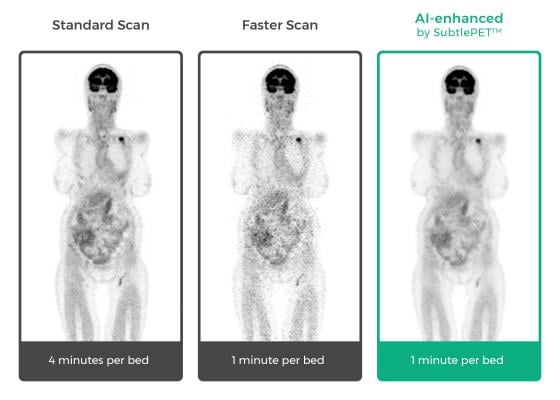
SubtlePET leverages AI to allow hospitals and imaging centers to accelerate positron emission tomography (PET) scan times four-fold or reduce PET radiation dose by up to 75 percent, according to the company.
A second product pending FDA submission is SubtleMRI, which allows imaging centers to significantly accelerate magnetic resonance imaging (MRI) scans. Subtle Medical’s focus on image acquisition and workflow differentiates it from most AI imaging companies, which are focusing on post-processing and computer-aided diagnosis.
Subtle Medical technology utilizes deep learning algorithms that integrate seamlessly with any original equipment manufacturer (OEM) PET and MRI scanners to enhance images during acquisition without any interruption or alteration in the imaging specialists’ workflow. The result is shorter scan duration or less exposure to radiation, which is particularly beneficial for children and those undergoing repeat PET exams.
In March 2018, Subtle Medical received the NVIDIA Inception Award Top Healthcare+AI Startup Globally from among over 3,000 AI contenders. The company was also selected as the first AI+healthcare startup for Bessemer Venture Partner’s Deep Health Seed Program.
Subtle Medical’s core technology was developed at Stanford University. The company has licensed multiple patented technologies invented by the founders at Stanford as well as medical imaging datasets acquired during clinical research at Stanford radiology labs.
At RSNA 2018, Subtle Medical’s co-founders will be participating in research and industry presentations along with other academic collaborators from Stanford. Presentations include:
Lunch and Learn: Thinking Faster, Safer, & Smarter: How You Can Use AI to improve MR and PET Imaging Efficiency, Patient Satisfaction, and Safety
Greg Zaharchuk, M.D., Ph.D. |Chris Hess, M.D., Ph.D. | Paul Chang, MS, M.D. | Michael Brant-Zawadzki, M.D., FACR
Wednesday 12:30-1:30 PM | LL33
Machine Learning Theater: AI Improves Imaging Workflow for MR and PET Exams: Faster, Safer, and Smarter
Greg Zaharchuk, M.D., Ph.D. |Enhao Gong, Ph.D.
Monday 12:00-12:20 PM | ML23
Evaluation of Deep-Learning-Based Technology for Reducing Gadolinium Dosage in Contrast-Enhanced MRI Exams
Enhao Gong, Ph.D. | Jonathan Tamir, BSC | John Pauly | Max Wintermark, M.D. | Greg Zaharchuk, M.D., Ph.D.
Physics (MR: New Techniques, Systems, Evaluation)
Monday 10:30-12:00 PM | SSC12 | Presentation 9 of 9
Does 18F-FDG Dose Reduction for PET/MRI Affect Treatment Response Assessment of Lymphomas and Sarcomas?
Ketan Yerneni |Anne Muehe, M.D. | Praveen Gulaka, Ph.D. | K. Elizabeth Hawk, M.D., Ph.D. | Ashok Joseph Theruvath, M.D. | Heike Daldrup-Link, M.D.
Monday 12:45-1:15 PM | PD218-SD-MOB4
Stroke Outcome Prediction from Meta Information Available at Patient Admission
Yuan Xie | Bin Jiang | Enhao Gong, Ph.D. | Ying N. Li | Guangming Zhu | Bo Zhou | Patrik Michel | Max Wintermark, M.D. | Greg Zaharchuk, M.D., Ph.D.
Neuroradiology Series: Stroke
Wednesday 8:30-12:00 PM | RC505 | Presentation 10 of 12
Deep Learning Segmentation for Detection of Brain Metastases in the Small Data Regime
Daniel L. Rubin, M.D., MS | Greg Zaharchuk, M.D., Ph.D. | Michael Iv, M.D. | Rhea Singh
Neuroradiology (Dots and Dashes: Image Analysis in Neuroradiology)
Thursday 10:30-12:00 PM | SSQ15 | Presentation 8 of 9
For more information: www.subtlemedical.com

 October 07, 2026