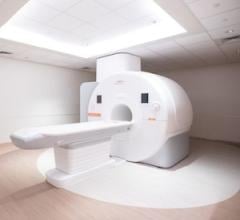
August 24, 2017 — MR Solutions’ 9.4T cryogen-free magnetic resonance imaging (MRI) system is designed for preclinical applications. The cryogen-free (“dry”) magnet system provides high-resolution imaging within a compact footprint.
The old wet magnet technology is very large and weighs in at around 5 metric tons, which demands floor reinforcement against 700 Kg for the newer dry magnet technology. This allows laboratories who have limited space to accommodate these very powerful scanners.
The area required to accommodate MR Solution’s 9.4T MRI system is around 8m2 to be comfortable, although it could fit within a 4m2 room on any floor compared with 15-20m2 (for a wet magnet system). It can be placed near other imaging equipment because it has a very small stray magnetic field. There is no need for costly helium top-ups as it is a dry magnet system. The cost of the MR system is much lower at around a third of the older wet magnet system, according to the company.
Wet magnet MRI systems require extensive and costly building modifications to accommodate the weight size, and height but also the quench lines, water supplies, pipework and ventilation. They need to be sited in a dedicated room with a Faraday cage built into the walls to screen the signals generated by the scanner from interference. The Faraday cage in the MR Solutions’ scanner is built into the cover.
MR Solutions has recently installed a 3T preclinical MRI system at the Norlux Neuro-Oncology Laboratory, part of the Luxembourg Institute of Health. Olivier Keunen, M.D., who is responsible for the In vivo imaging facility - head of support Service unit, said: “The size of our animal facility would not have allowed installation of a larger preclinical MRI system. Because of uncertainties about Institute buildings, the system had to be installed in a temporary location. Provision and plans are made for a move of the system to its final location when ready. The cryogen-free cooling and the avoidance of quenching pipes are expected to facilitate the transition.”
For more information: www.mrsolutions.com

 October 07, 2026