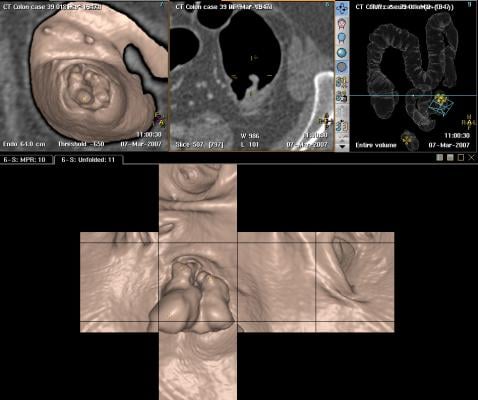
October 20, 2015 — The American College of Radiology (ACR) spoke out against the U.S. Preventive Services Task Force’s (USPSTF) exclusion of computed tomography (CT) colonography from its most recent list of recommended exams for colorectal cancer screening, saying the decision could be a significant blow to efforts to raise colorectal cancer screening rates.
According to the statement, this exclusion may result in countless unnecessary deaths and unnecessary healthcare spending. Under the Affordable Care Act, private insurers are only required to cover (with no copay) exams given a grade of “B” or higher. Medicare determines coverage separately. It is unclear how these draft USPSTF recommendations would affect coverage and resulting patient access, given that the USPSTF did not propose grades for specific screening technologies.
A recent study in Abdominal Imaging shows that screening Medicare patients with CT colonography would cost 29 percent less than with optical colonoscopy and save up to $1.7 billion per screening cycle. At least a third of those who should be screened for CRC are not getting tested because they can’t have or don’t want a colonoscopy. Studies show that CT colonography availability significantly boosts CRC screening rates which can detect more cancers early – when most treatable — and save lives.
“This USPSTF draft recommendation could restrict access to a major tool to help achieve the National Colorectal Cancer Roundtable goal of an 80 percent colorectal cancer screening rate by 2018. As a result, thousands may continue to die each year that could be saved through more widespread screening enabled by CT colonography,” said Judy Yee, M.D., FACR, chair of the American College of Radiology Colon Cancer Committee.
The ACR statement noted that the USPSTF cited a lack in "the maturity of the evidence" and “gaps in evidence on incidental findings” in not including CT colonography among their recommended screening exams. However, CT colonography is an American Cancer Society-recommended screening test. Studies in the New England Journal of Medicine and elsewhere prove CT colonography is comparably accurate to optical colonoscopy – including in those ages 65 and older.
CT colonography can spot cancers and other serious illnesses in organs other than the colon, including abdominal aortic aneurysms. This can lead to early diagnosis and treatment of previously undetected problems. However, the recent Abdominal Imaging study and others have shown that CT colonography does not result in an inordinate number of incidental findings requiring additional or unnecessary workup.
The ACR response also noted that the Task Force omitted from its recommended list a stool DNA screening test previously approved for coverage by the Centers for Medicare & Medicaid Services (CMS). Studies show that CT colonography identifies colorectal cancer and precancerous polyps far better than the stool DNA test, is more cost-effective and results in fewer ”false-positive” exams, which can reduce downstream costs and patient anxiety. CT colonography is recommended every five years while the DNA test would be done every three years. This less frequent testing may further lower costs and attract more people to be screened.
“CT colonography’s ability to detect cancer and precancerous polyps far exceeds the standard that CMS applied to the DNA test. Transparent, consistent, evidence-based approval and the need for more screening options for the nation’s second leading cancer killer, require that Medicare now cover beneficiaries for CT colonography,” said Yee.
The draft USPSTF recommendation, if finalized, would prolong a two-tier system where seniors are not covered for a lifesaving exam already covered by CIGNA, UnitedHealthcare, Anthem Blue Cross Blue Shield and other large insurers. Meanwhile, nearly 133,000 Americans are expected to be diagnosed with colorectal cancer in 2015. Nearly 50,000 Americans will die of the disease.
“This erratic USPSTF recommendation would force seniors who want a CT colonography to continue to pay for the exam out of pocket — on top of the annual Medicare premium. Many seniors, who might not get tested otherwise, can’t overcome this financial barrier to care and may ultimately pay with their lives,” said Yee.
For more information: www.acr.org

 October 07, 2026