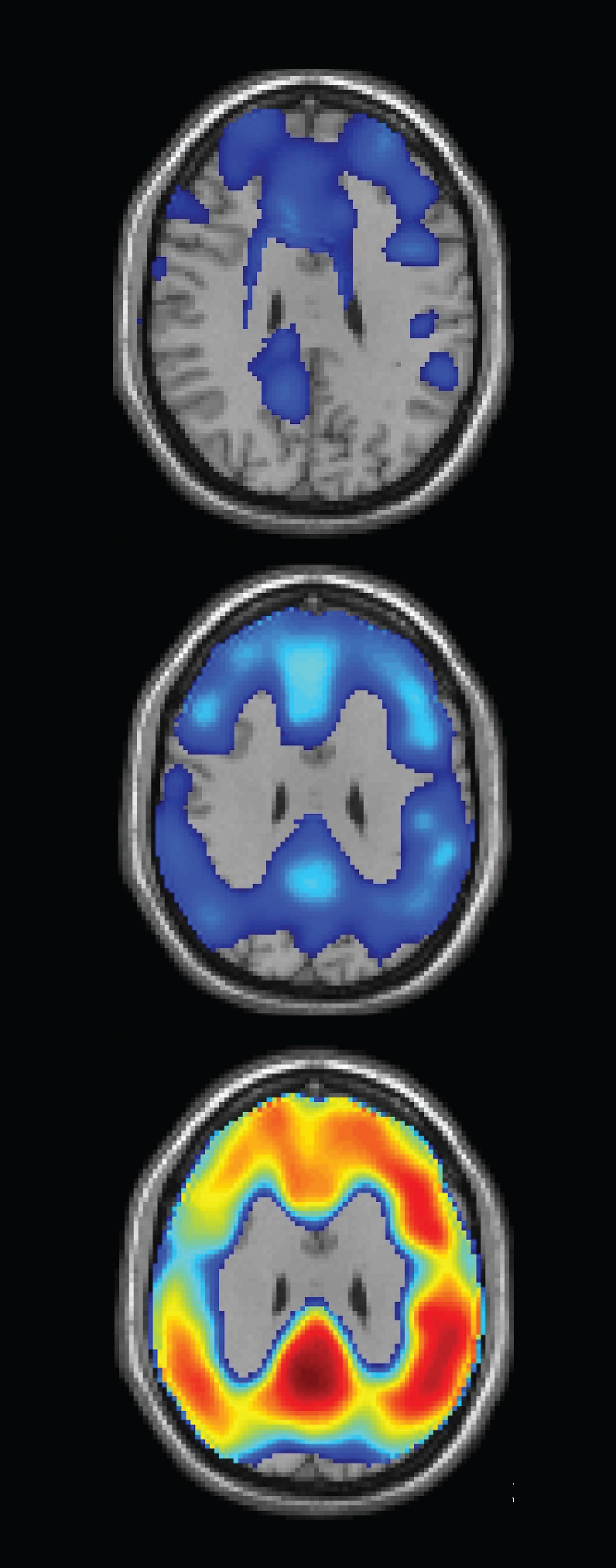
June 11, 2014 — Many people develop depression in the latest stages of life, but until now doctors had no idea that it could point to a build up of a naturally occurring protein in the brain called beta-amyloid, a hallmark of Alzheimer’s disease. In fact, late-life depression could become a major risk factor for developing Alzheimer’s faster than others, according to research unveiled at the Society of Nuclear Medicine and Molecular Imaging’s 2014 Annual Meeting (SNMMI).
Alzheimer’s disease is a currently incurable neurodegenerative disease with marked protein aggregates including beta-amyloid and tau. The disease begins developing years before noticeable cognitive decline and memory loss. Depression has been proven to have its own neurodegenerative effects on the brain, but here researchers have found an undeniable connection between beta-amyloid in depressed elderly patients with cognitive deficits and advancement to Alzheimer’s disease. They were able to prove this using molecular imaging data from a global dementia imaging database.
“Our results clearly indicate that mild cognitively impaired subjects with depressive symptoms suffer from elevated amyloid-levels when compared with non-depressed individuals,” said the study’s principal scientist Axel Rominger, M.D., from the department of nuclear medicine at the University of Munich in Germany. “The combination of elevated amyloid-levels and coexisting depressive symptoms constitute a patient population with a high risk for faster progression to Alzheimer’s disease.”
The clinical study involved 371 patients with mild cognitive impairment who underwent PET imaging with the radiotracer F-18 florbetapir and magnetic resonance imaging (MRI) chosen retrospectively from the Alzheimer’s Disease Neuroimaging Initiative (ADNI) database, which includes data from at least 55 research centers across the United States and Canada now readily available to more than 2,500 researchers worldwide. Results showed that mild cognitive impaired patients with depressive symptoms had higher amyloid deposition than non-depressed controls as indicated by the binding of the radiotracer to amyloid particularly in the frontal cortex and the anterior and posterior cingulate gyrus of the brain, both involved in mood disorders such as depression.
“Therapeutic options for Alzheimer’s disease are still limited and therefore the identification and understanding of contributing risk factors that influence the disease are crucial in ongoing research as they offer the possibilities for future medical intervention,” said co-author and fellow researcher Matthias Brendel. Additionally, knowing the risk could help patients make necessary lifestyle changes and prepare their families.
For more information: www.snmmi.org

 October 16, 2026