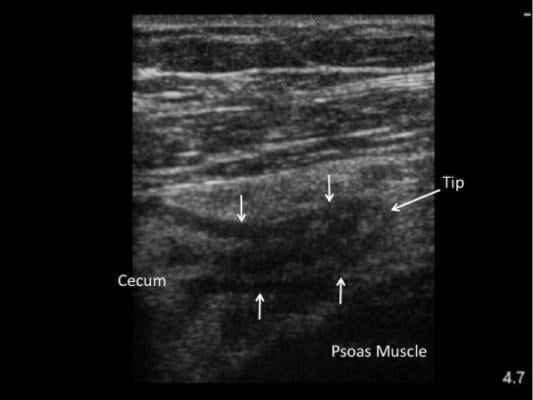
February 28, 2014 — Using portable ultrasound as a first-line imaging study in kids with suspected appendicitis helps reduce emergency room length of stay and reduces the need for CT scans, according to a team of Mount Sinai researchers. Point-of-care ultrasonography has a specificity of about 94 percent. Results from the study were published online Feb. 10 in the peer-reviewed journal Academic Emergency Medicine.
“From an institutional perspective, this is the most common surgical problem that we encounter with children in the emergency department,” said the study’s senior author, James W. Tsung, M.D., M.P.H., associate professor of emergency medicine and pediatrics at the Icahn School of Medicine at Mount Sinai. “CT scans have been the best imaging test for diagnosing appendicitis, but they expose children to radiation, which cumulatively can prove harmful, as increasing numbers of studies have shown.”
Several studies have reported lifetime risks of cancer from abdominal and pelvis CT in children between 1 fatal cancer cause for every 500 to 3,000 CT scans ordered, depending on age and sex. Efforts to try to reduce the 4 million radiation-emitting CT scans obtained in children every year are underway, led by front-line physicians, radiologists and radiological professional societies.
“CT scanning rate was reduced by over 35 percent, from a 44 percent CT scan rate prior to the study to a 27 percent rate during the study,” said Ee Tay, M.D., assistant professor of emergency medicine and pediatrics, Icahn School of Medicine at Mount Sinai, and the study’s second author.
In the study, investigators used a prospective observational convenience sample of 150 children seen consecutively between May 1, 2011 and Oct. 1, 2012 in an urban pediatric emergency department. All children were under evaluation for suspected appendicitis. Outcomes were determined by surgical or pathology report in those found to have appendicitis and three weeks later in patients who were deemed not to have appendicitis. Operator accuracy reading the ultrasounds was reviewed in a blinded fashion by trained pediatric emergency medicine sonologists. The time to perform the point-of-care ultrasound and CT scan use was measured.
The study showed that emergency department length of stay declined by 2 hrs and 14 minutes (46 percent decrease) for those requiring radiology department ultrasound and nearly 6 hours (68 percent decrease) for those requiring CT scan when point-of-care ultrasound was inconclusive as a first-line imaging study. No cases of appendicitis were missed with the point-of-care ultrasound protocol and no unnecessary surgeries were performed for a normal appendix. With focused ultrasound training, pediatric emergency clinicians were able to evaluate ultrasound exams with the similar accuracy as radiologists (about 94 percent accuracy).
The Mt. Sinai Division of Emergency Ultrasound is involved with an effort to educate providers at Mount Sinai Hospital to use safer ultrasound as a faster first-line study in kids. The lead investigator, Inna Elikashvili, M.D., was a clinical fellow at the Icahn School of Medicine at Mount Sinai when the research was submitted to the journal.
For more information, visit www.mountsinai.org

 October 07, 2026