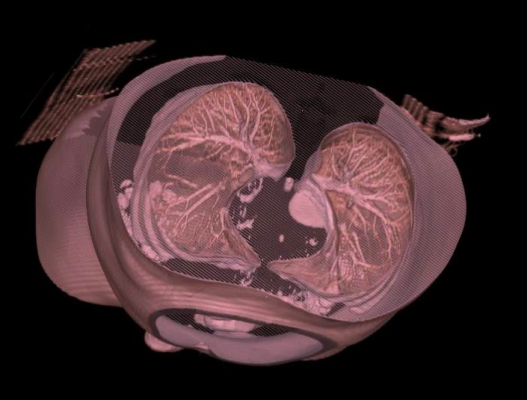
Lung cancer is associated with very high mortality, in part because it is hard to detect at early stages, but also because it can recur frequently after surgical removal. The question arises as to what is the best way to follow lung cancer patients after surgery in order to spot problems early enough, before symptoms become obvious, so that patients may still be eligible for new interventions. In this study presented at the 93rd AATS Annual Meeting, investigators from the University of Toronto departments of Thoracic Surgery and Diagnostic Radiology show that minimal dose computed tomography (MnDCT) of the thorax offers much greater sensitivity at detecting new or recurrent lung cancer, with equivalent amount of radiation, compared to conventional chest X-rays.
"Up to a few years ago, we were using chest x-rays to monitor patients after surgery for lung cancer, but this follow-up was ineffective, and many patients still died of recurrent lung cancer, comments lead investigator Waël C. Hanna, MDCM, MBA, of the Department of Thoracic Surgery at the University of Toronto. "While CT scans can effectively be used to monitor lung cancer after surgery, there was significant concern about the large amount of radiation that will be delivered to patients, and standard dose CT scans were not used routinely in the follow-up of lung cancer. More recently, new technology allowed us to develop MnDCT."
As reported in this study, the majority of new or recurrent cancer was detected by MnDCT at a subclinical, intrathoracic stage, within two years of surgery. This allowed for the delivery of curative treatment in the majority of patients with asymptomatic cancer and was associated with long survival.
The study followed 271 patients with lung cancer (80 percent Stage I, 12.5 percent Stage II) who underwent curative resection of lung cancer. Repeated imaging occurred at 3, 6, 12, 18, 24, 36, 48 and 60 months using both standard chest x-rays and MnDCT.
Investigators found that MnDCT detected 94% of recurrent cancers compared to only 21% with standard X-rays (p<0.0001). Importantly, the recurrent lung cancer was detected at a much earlier stage, allowing patients to possibly undergo another curative surgery.
Detection of a new or recurrent cancer in asymptomatic patients led to further surgery or radiation for 75.5 percent, while palliative treatment was recommended for the remainder of patients. Survival in the treated group was significantly longer than those who were treated with palliative intent (69 months vs. 15 months, p<0.0001).
"MnDCT offers the best of both worlds: on the one hand it allows for precise imaging close to what is produced from a standard CT scan, and on the other hand it only delivers a small amount of radiation which is comparable to what a regular X-ray would deliver and much less than a standard dose CT scan," says Hanna. "More importantly, now we can detect recurrent lung cancer at a much earlier stage, allowing patients to possibly undergo another surgery, and live longer, healthier lives."
The study did find that MnDCT results produced a high rate of false positives, and the need for surgeons to be alert to this limitation in order to make correct clinical judgments regarding follow-up treatment.

 October 07, 2026