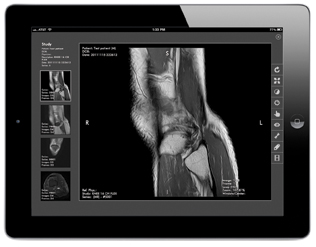
With tablet technology, doctors -- and patients -- can access images from any location. (Image courtesy of DICOM Grid)
Multiple industries have undergone a complete metamorphosis as a result of advancing electronics, and the medical world is no exception. Perhaps a little late to recognize the technological transformation, the healthcare industry is finally catching on to the latest trends and incorporating the newest devices into everyday use. One device, in particular, is going to revolutionize medicine forever.
Ironically the power player that is mobilizing healthcare is one of the smallest computers on the market today. Weighing in at only 1.44 pounds, the heavyweight champ is (drum roll, please)…the tablet. Tablet devices are going to change the way we see medicine. Medical apps are assisting doctors with their day-to-day assessments, and mobile viewers are altering the way patient information is exchanged and accessed.
Mobile Viewers are Changing Healthcare
In an increasingly technologically savvy world, people want information to be at their fingertips when and where they need it. Now, the same is expected for medical images. Doctors and patients alike demand access to images from any location.
Soon the days of unreadable CDs and clunky film radiographs will be distant memories. Patients will no longer hold the burden of having to remember to bring their medical images with them to an appointment. Instead, their entire medical history and associated radiographs will be immediately accessible in the cloud. With advancing technologies, patients can upload images to second opinion specialists and other care providers ahead of time. This allows the doctor to have an idea of the patient’s condition before the individual even arrives at the office. The cloud also prevents patient exposure to duplicate radiation and the unnecessary time incurred for procedures by medical staff.
Doctors can more readily exchange information with out-of-network facilities anywhere in the world. More impressively, doctors are granted the ability to view these images from any location with tablet devices. This real-time acquisition process is especially critical in emergency situations. Instead of rushing into the office to view an image, medical personnel can make preliminary diagnoses right from home. In larger institutions, mobile viewers allow multiple doctors to view the same studies simultaneously, which is especially useful for consultative purposes.
Tablets facilitate an interactive approach to healthcare. With the mobility of these devices, doctors can explain procedures in a comprehensive manner. Being more informed about their conditions allows patients to become actively involved in their own healthcare, permitting them to make more knowledgeable decisions about treatment plans.
The Future Structure of Healthcare
Porter Research expects that over the next five years, mobile phones and portable medical devices will be the main sources of connectivity in the medical realm. Tablets will not only be the method of choice for linking healthcare providers to one another, they will also be the core method of contact for patient-doctor communication. While many healthcare organizations already have plans in place to adapt to this change, medical facilities everywhere will need to enhance or develop wireless strategies to support this increasingly useful form of communication. More and more hospitals are placing a greater importance on improving mobile healthcare solutions. This is a trend that will increase in the near future.
Mobile viewers and tablet devices are here to stay. As mobility becomes a more integral part of the healthcare process, the medical facilities that embrace these technologies will prosper.
Ricardo Cury, M.D., FSCCT, serves as the director of cardiac imaging at Baptist Hospital of Miami and Baptist Cardiac and Vascular Institute, as well as radiology chairman and CEO of Radiology Associates of South Florida, and vice chairman of radiology at Florida International University. Dr. Cury uses the DICOM Grid mobile application in his practice to access images from tablet devices.
 October 23, 2026