

Greg Freiherr has reported on developments in radiology since 1983. He runs the consulting service, The Freiherr Group.
Blog | January 10, 2013
Exploding Imaging Volume Could Taint Radiology
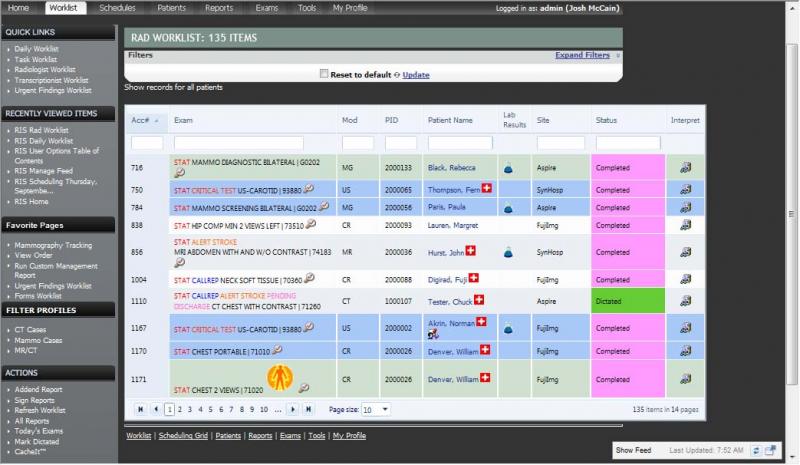
Increasing procedure volume, brought on by pending healthcare reforms, may put a premium on software that can automate and streamline workflow. (Synapse RIS 6.2 courtesy of FujiFilm Medical Systems)
The radiology community may be in for a shock soon. Regents Health Resources, a national consulting firm specializing in medical imaging business intelligence, suggests that the volume of imaging exams is about to explode.
Regents estimates that new coverage under healthcare reform will lead providers to perform millions more exams than in years past. Californians alone could receive almost 9 million additional exams. Across the country, medical imaging procedures are forecast to rise 13.6 percent, which translates into 61 million more procedures annually.
The fallout is easy to predict. If procedure volumes rise, as Regents predicts, it would quickly absorb the over-capacity that now exists in some imaging operations. This would put a premium on efficient patient handling and, inevitably, lead facilities to extend their hours of service to handle the increased load, as managers plan drastic changes in technologies and staff management as longer term fixes.
Likely to be put in place will be IT solutions that help providers handle rising volume, as well as machines optimized for throughput. The very practice of medical imaging is likely to change. MR suites, for example, may cut down on the number of sequences they run in order to shorten exams, focusing on sequences that produce the most diagnostic data in the shortest time.
Meanwhile, look for a lot of angry chest pounding from budgeteers who didn’t see this coming. Savings from imaging reimbursement cuts that were mandated by the Deficit Reduction Act and took effect five years ago will be vastly outweighed by the increased volume of new exams. Regents forecasts that additional procedures will add $4 billion to Medicare and Medicaid expenses in just the six states hit hardest by the expected surge in demand — California, Florida, Massachusetts, New York, Tennessee and Texas.
The real risk to radiology, however, will come from short-term answers inappropriately applied by referring physicians who order the wrong exams and the docs who do their own imaging. Low-cost substitutes may be wedged into places where higher cost, premium performance technologies belong. Look for ultrasounds and radiographs to be performed when CT and MRI would ordinarily be used. Misdiagnoses and substandard care in such cases could smear medical imaging.
To date organized radiology has failed to get across to the general public the value that imaging brings to patient management. In the months and years ahead, we need to find a way to do so or the imaging community could be irreparably harmed.
Related Content

News | Artificial Intelligence
Oct. 7, 2026 – CARPL.ai has announced a collaboration with HOPPR that will give healthcare providers access to HOPPR's ...
 October 08, 2026

Feature | Digital Pathology | Kyle Hardner
As recently as a decade ago, pathology technology was expected to become more expensive, larger and more precise. Yet in ...
October 02, 2026 
News | ASTRO
Sept. 29, 2026 — The American Society for Radiation Oncology (ASTRO) has named Siemens Healthineers the inaugural ...
September 29, 2026 
News | Computed Tomography (CT)
Sept. 17, 2026 — Royal Philips and Southwest Mississippi Regional Medical Center (SMRMC), which serves as the hub of ...
September 24, 2026 
News | Radiology Education
Sept. 16, 2026 — As urgent care centers and outpatient healthcare facilities expand their use of diagnostic imaging, the ...
September 17, 2026 
News | PET Imaging
Sept. 10, 2026 — Siemens Healthineers Molecular Imaging has completed a $43.6 million construction and renovation ...
September 14, 2026 
Feature | Artificial Intelligence | Kyle Hardner
A radiologist pulls up a chest CT scan flagged for a pulmonary nodule. One artificial intelligence (AI) tool writes its ...
September 09, 2026 
News | Radiology Business
August 18, 2026 – NewVue, a provider of cloud-native software that unifies how radiologists work while improving ...
August 25, 2026 
Feature | Artificial Intelligence | Madhu Jahagirdar
Radiologists spend much of their day moving between different systems: One application to review images. Another to ...
August 17, 2026 
News | X-Ray
Aug. 10, 2026 — Teledyne Technologies Inc. and Varex Imaging Corp. have jointly announced that they have entered into a ...
August 14, 2026 © Copyright Wainscot Media. All Rights Reserved.

Subscribe Now