

Greg Freiherr has reported on developments in radiology since 1983. He runs the consulting service, The Freiherr Group.
Blog | January 05, 2012
MR Patient Comfort Rings in the New Year
Think oval. That’s what you’re doing if you are Hitachi Medical. The company came out with a novel design for high-end magnetic resonance (MR) at the RSNA meeting a couple of months ago, a design that compresses the decades-old circle into an ellipse. The thinking is elementary. The human body is wider horizontally across the shoulders than it is vertically through the chest. Add to that the less than flattering fact that we tend to flatten out when we lie down, especially those of us over the age of 40. So why not add the room in the bore where it is most needed?
The 1.5T Hitachi Echelon Oval does that, laying claim to being the widest of the wide bores, at least along one plane. Horizontally, the Echelon Oval bore extends 74 cm — 4 more than competing circular wide bores. According to Hitachi, its oval is wide enough to fit the most and least athletic of us, while helping to calm the nearly claustrophobic.
Time will tell whether the oval will catch on — or even if it will hang on as an alternative to conventional wide bores. But that’s not really the point. More significant is that the Echelon Oval exists at all.
Hitachi led the open scanner revolution in the mid- to late 1990s. Today, the company is just one of two that offers a commercial system at true high-field, the 1.2T Hitachi Oasis (http://www.itnonline.com/article/hitachi-oasis-mr-receives-klas-award-r…). The other is Philips with its 1T Panorama HFO (http://www.itnonline.com/article/open-mri-opens-opportunities-referring…).
The significance of the Echelon Oval is that, in releasing this oval-shaped wide bore, Hitachi — the pioneer of the open — concedes that 1.5T is beyond the grasp of the open architecture. This concession comes even as the MR community has moved on to 3T.
Together, these developments all but seal open MR as an anomaly on the timeline of MR. If a 1.5T cannot be developed as an open, an open 3T scanner is all but impossible, at least as a commercial development.
So it is with some sorrow in the passing of this grand venture in engineering that we must accept the fact that the open as a future technology is dead.
Long live the ring.
Related Content

News | FDA
Oct.7, 2026 – MRI2CT Inc. has received FDA 510(k) clearance for NextMR, its AI powered imaging platform, for generating ...
 October 07, 2026


News | Information Technology
October 6, 2026 – Clearsense has introduced a cloud-based medical image archive designed to reduce the cost of ...
October 07, 2026 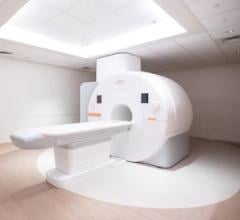
News | PET-MRI
Sept. 29, 2026 —Yale New Haven Hospital has installed a state-of-the-art positron emission tomography/magnetic resonance ...
October 05, 2026 
News | Radiology Imaging
Aug. 13, 2026 — Epic's new Care Everywhere Diagnostic Image Exchange allows health systems using Epic to share ...
August 21, 2026 
News | Cardiac Imaging
Aug. 20, 2026 – The novel, radiopaque, polymer-based embolic coil from Embolization, Inc. has now surpassed 125 implants ...
August 20, 2026 
News | Radiology Business
Aug. 4, 2026 — Canon Medical Systems USA (CMSU) has appointed Tsuneo "Neo" Imai as president and chief executive officer ...
August 10, 2026 
News | Radiology Imaging
Aug. 4, 2026 — A new study from the Harvey L. Neiman Health Policy Institute found that the time between an imaging scan ...
August 06, 2026 
News | Contrast Agents
Aug. 5, 2026 — Bracco Group is bringing a newly authorized macrocyclic gadolinium-based contrast agent (GBCA) for ...
August 05, 2026 
News | Neuro Imaging
July 9, 2026 — Viz.ai has announced a collaboration with Cortechs.ai to integrate Cortechs.ai's NeuroQuant and ...
July 10, 2026 
News | MRI Breast
July 2, 2026 – Quibim has announced the European and UK launch of QP-Breast, its CE and UKCA-marked AI tool which ...
July 02, 2026 © Copyright Wainscot Media. All Rights Reserved.

Subscribe Now