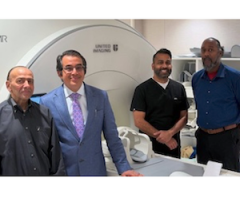
August 18, 2011 – The Methodist Hospital Research Institute in Houston, Texas, and Philips Healthcare have collaborated to develop new magnetic resonance imaging (MRI) and molecular imaging technology that could be used to help identify the start and cause of an infectious disease epidemic.
King Li, M.D., radiology chair and the project's leader, and other Methodist scientists will use an $8.6 million imaging suite that includes an MRI, a positron emission tomography (PET)-computed tomography (CT) scanner, a SPECT-CT scanner, and an X-ray device called a C-arm to study patterns of tissue damage and metabolic disarray caused by different infectious disease agents -- without exposing the devices or suite rooms to the infectious agents. The suite is scheduled to be completed later this month.
"The ability to have imaging suites that can handle high level infectious agents allows us to be more prepared in the community for these types of events and, more importantly, allows us to study ways to deal with their consequences," Li said.
Air-tight containment vessels make it possible for samples and infected research models to be imaged without posing risks of exposure to patients, researchers or staff. Advanced technology also allows for rapid image scanning, so that time series imagery is possible.
"No one can do longitudinal imaging studies anywhere at the moment," said Ed Jones, vice president of operations for The Methodist Hospital Research Institute. "Researchers at Methodist will be able to do live imaging studies that give them crucial information about how and where infections are progressing. This is what can happen when the best scientists and engineers from academia and industry become partners in advancing the state of the art in medical technology."
Methodist will be the sole practical test site for the development of the technology.
The purpose of the suite is to study pathogens that require biosafety level 3 (BSL-3) containment. BSL-3 pathogens include the bacteria that cause tuberculosis.
"This imaging facility will be the first of its kind," said James M. Musser, M.D., Ph.D., chair of the Department of Pathology and Laboratory Medicine and director of the Center for Molecular and Translational Human Infectious Diseases Research at The Methodist Hospital. "Our facility will permit us to translate critical new discoveries into the clinic, permitting accelerated development of novel diagnostic strategies and assessment of new therapeutic agents and vaccines."
King Li said the notion that imaging techniques might be used to shield populations from epidemiological harm is nearly a decade old.
"After 9/11 and the SARS outbreak in southeast Asia, the NIH wanted to build a BSL-4 imaging suite for studying infectious agents, both natural and bioterrorism-related," Li said. "I was at the NIH at the time, and helped design the imaging equipment for that facility.”
Li's work with Philips led to two pending imaging patents.
A containment vessel will keep the subjects -- initially model organisms -- isolated from the unexposed space around it. Each vessel, or imaging cell, is accompanied by an external life support device on a transport trolley. The trolley is also used to maneuver the subject into place for imaging.
One of the project's ultimate goals, Li said, is to develop a similar facility that is equipped to diagnose infectious diseases in a large influx of (human) patients.
"If the partnership with Philips is successful, The Methodist Hospital Research Institute can take the next steps toward creating the only clinic in the world expressly designed to image patients with infectious agents, such as multi-drug-resistant TB," Li said. "This will allow for medical centers in the world to be more prepared for emerging diseases and bioterrorism."
The specific systems provided by Philips are the Ingenia 3T (MRI scanner), Gemini TF 64 PET-CT scanner), Precedence 16 (SPECT-CT scanner), and Veradius mobile C-arm.
For more information: www.philips.com

 August 21, 2026