August 5, 2011 – Microscopic gold particles could multiply the effectiveness of standard cancer radiation therapy by acting as tiny missiles that destroy blood vessels feeding cancerous tumors. Early research about this method, which could shorten cancer treatment and make it more effective, was presented at the 2011 Joint Meeting of the American Association of Physicists in Medicine (AAPM) and Canadian Organization of Medical Physicists (COMP).
The addition of gold nanoparticles to radiation therapy is a new approach to improving cancer treatments. The study presented focuses on the combination of gold nanoparticles and brachytherapy, a type of radiation treatment in which rice-sized low-energy radiation-emitting seeds are implanted near or within cancerous tumors. Like other forms of radiation therapy, brachytherapy damages the DNA of cancer cells, leading to their death. Supplementing brachytherapy with gold nanoparticles would add a new cancer-killing mechanism that collapses the blood vessels, effectively strangling the tumor, the research suggests.
“The idea is to deliver a one-two punch to the cancer: bombard the tumor with standard radiation therapy while also attacking its blood supply,” said Ross I. Berbeco, Ph.D., lead author of the study and staff physicist at Brigham and Women’s Hospital, Dana-Farber Cancer Institute, and assistant professor at Harvard Medical School, Boston. “Although we have also shown that the concept may work for external beam radiation therapy, brachytherapy is particularly attractive for this idea due to the way this low-energy type of radiation interacts with the gold.”
The research suggests that gold nanoparticles may act as a vascular disrupting agent (VDA), cutting off the flow of blood to the tumor by destroying the cells that line tumor-feeding blood vessels. Most VDAs are delivered through chemotherapy, and studies have shown supplementing radiation with VDA chemotherapy may improve cancer treatment. The Brigham and Women’s research suggests that the gold nanoparticles could destroy the blood vessels at the same time radiation therapy is administered.
To test their concept, researchers performed a computer simulation of gold nanoparticles in a tumor blood vessel cell, where brachytherapy seeds had been placed nearby. Results show the gold nanoparticles boost the radiation dose to the blood vessel cells. The researchers next will test the method in live cancer cells.
“We think this is an exciting opportunity for a low-risk, high-reward procedure that could improve cancer care,” said co-author Wilfred F. Ngwa, Ph.D., research fellow at Brigham and Women’s Hospital, Dana-Farber Cancer Institute, and Harvard Medical School, Boston.
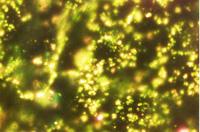
One million times smaller than the head of a pin, the nanoparticles would be dispersed in a liquid that could be injected into the blood stream. Molecules or proteins attached to the nanoparticles would direct them to target the tumor blood vessel. Gold is an ideal material for this type of therapy because it is relatively non-toxic and its high atomic number boosts the brachytherapy radiation dose.

 October 01, 2026