April 19, 2011 – Andrew Einstein delivered the Douglas P. Zipes Distinguished Young Scientist Award Lecture entitled "Effects of Radiation Exposure During Cardiac Imaging: How Good Is the Data?" at this year's American College of Cardiology annual scientific sessions. The field of cardiac computed tomography (CT) angiography has been proactive and responsible in developing and employing significant radiation sparing techniques in response to the concerns raised by Einstein and others.
The Society of Cardiovascular Computed Tomography (SCCT) considers radiation exposure during imaging a matter of utmost importance and supports the tremendous amount of work by vendors and clinicians to reduce unnecessary radiation exposure from diagnostic cardiac CT angiography. Firstly, the SCCT verification program supports the rigorous published cardiac CT training guidelines, which mandate extensive education in radiation safety and radiation reduction techniques for all Level II and Level III certified clinicians. In fact, radiation exposure from cardiac CT has been reduced by about 80 percent (15 mSv to 3-4 mSv) through advances in technology, protocols and algorithms, especially within the last two or three years. The average radiation exposure dose for cardiac CT angiography is now equal to and often less than that of invasive diagnostic cardiac angiography and is substantially lower than that of cardiac SPECT (single photon emission computed tomography) and PET (positron emission tomography) imaging. Published reports document radiation doses for common cardiac diagnostic tests as follows: prospective (state of the art) CT angiography protocols: 2-4 mSv; retrospective (older) CT angiography protocols: 12-18 mSv; diagnostic invasive coronary angiography: 7 mSv. SPECT perfusion studies: 12 mS; average annual background radiation exposures (United States): 3 mSv.
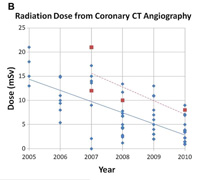
A 2010 article by Raff et al entitled "Radiation dose from coronary CT angiography: Five years of progress (published in the Journal of Cardiovascular Computed Tomography, Vol. 4, No. 6, November/December 2010) demonstrates the significant radiation reductions resulting from advances in the field. This point is illustrated by the following figure from his article (reproduced with the permission of Elsevier (Copyright Elsevier 2010).
Figure 1 (B) Radiation dose by year. Blue symbols indicate research reports by publication date; blue line, linear regression of reported research doses; red squares, multicenter clinical reported doses listed by year data collected; red line, linear regression of reported clinical survey doses.
In addition, preliminary data suggest that cardiac CT angiography may reduce the number of unnecessary SPECT and invasive angiographic studies. The SCCT also supports the inclusion of radiation dose reporting in the same document as the clinical report.
Further work in this area is ongoing and there have been more recent publications, including abstracts at these very scientific sessions, documenting the effectiveness of these radiation-sparing techniques.
The SCCT recommends that diagnostic radiation be utilized judiciously, in line with the principles of ALARA (as low as reasonably achievable) and that it be individualized to each patient, weighing the radiation exposure risk versus diagnostic testing benefit. Diagnostic radiation should only be prescribed when the benefits of a particular test are felt to outweigh any potential harm from the resulting radiation exposure. In addition, the SCCT recommends following the published guidelines and appropriate use criteria regarding indications for diagnostic and screening cardiac imaging studies.
Matthew Budoff, M.D., FSCCT, professor of medicine, Los Angeles Biomedical Research Institute, SCCT president adds, "We [SCCT] vigorously support awareness of radiation safety and the adoption of a policy of responsible diagnostic radiation use. We encourage ongoing efforts to continue the excellent work taking place in the area of diagnostic radiation reduction techniques and radiation exposure monitoring. We are encouraged that the increased awareness has led to improvements in patient dose. Most of our members have reported dose reductions up to 70 percent at their institutions for cardiac CT angiography."
For more information: www.SCCT.org

 October 07, 2026