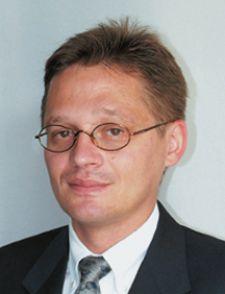
Michael Palazzola is CEO of Ziehm Imaging Inc.
What is Ziehm's mission in the U.S. market?
Strobel: In imaging, with our competitors, we are a little bit smaller in size. We are a technology-driven company, so that means we try to be innovative, and we deliver new products and new solutions in a short rate. What we need for that is market perceptiveness. Many people come here to learn about the latest medical advancements. We are able to identify trends and convert them within our innovative engineering company so that we have new products ready to go.
Ziehm is well-established in Europe, but now you want to extend your reach more deeply into the U.S. and youÕre facing some major players like GE Healthcare, Siemens and Philips. What is it about Ziehm that is going to move the company forward?
Strobel: At the end, it is all about the products we have that we are showing here [during a recent company meeting in Las Vegas]. They are innovations that result in clinical benefits. These are our strengths we have to offer, and what we have to work on is the brand. We have to create brand awareness for the U.S. market. We have the tools and the product, but we need the powerful brand.
What is it about the brand and the technology that you believe makes it superior to the name brands in the U.S. market today?
Palazzola: Let me address a little bit of the history of that. The Ôwhy we have this devoted group of people who love this product and have kept it alive when you consider all of the competitionÕ is that it is the best mobile machine. Everything else is so much larger or bulkier and difficult to get around. You get a great image quality, and we have a machine that is mechanically flexible enough to work around the surgeons and physicians out there that need it. That is what has kept us going.
Ziehm really stresses the idea of the mobile and flexible technology. Do you have a particular customer in mind?
Palazzola: I think there is a movement underway in hospitals that [clinicians] want to utilize as much as they can. Such a variety of equipment and different machines are used in surgical suites, wheeled in and out of them consistently. The combination of the technology is getting better, and the need to diversify the real estate in the hospital is becoming more important. It is a migration that we are benefiting from.
So you see hospital surgical suites not incorporating a lot of permanent fixtures in terms of equipment and technology and Ziehm wants to capitalize on that?
Palazzola: Think of the analogy of what has happened in ultrasound in the last two years. It used to be that for ultrasound you had to sit in some dark room that was dedicated to the equipment. Then the machines got smaller, and the operator simply picked it up and moved it to the patient, instead of moving the patient around, which is a very slow process at a hospital. On a much larger scale that is happening in the imaging cycle of all the modalities.
Strobel: IÕd like to comment on an earlier question about why we think we can compete with the so-called big [companies]. They have great engineers, skilled engineers. But I think our main advantage is that we have been working on that mobile [C-arm] for more than 35 years now. That is what we are focused on. The big ones go in with technology that surpasses the focus and then they try to take this technology and downgrade it to a mobile imaging system, which is the wrong way because the mobile imaging system, with respect to the requirements, is completely different. The patient is the focus.
What I hear you saying is Ziehm has focused on the mobile aspects of technology whereas other companies focused on fixed equipment and then recreated it into a mobile unit.
Strobel: That is our understanding, yes. We have only been working on the mobile model, understanding that we are building a tool. We utilize high technology and thatÕs what we present to the outside. Talking about a CT, you know, itÕs neat stuff. The same with a mobile CR; it is so big and has so many buttons to press.
How is it easier to use than say, something your competition would make?
Stršbel: For example, the Ziehm Vision includes a feature called ODDC [Object Detected Dose Control]. It does automatic motion detection, it checks the pulse rate and the pulsing parameters for automatic dose reduction, and metal correction to eliminate artifacts, such as blooming. We are taking away a lot of [button pushing] from the [process] for the physician.
What do you see as the next big technological change that will advance C-arm technology in years to come?
Strobel: I think that the range of applications for a mobile unit is a pretty straightforward requirement. Motorization that involves some kind of more intelligent movement is one change.
Are you talking about voice activation or remote control?
Strobel: Remote control by pressing a button. We have begun to do voice control with some participants but it is not well accepted. Another solution we provide that physicians like more is we have these [handles] to open and close the brakes of the different movements of the C-arm. One of our physician customers asked if we can make them different colors so he could be able to tell his [colleagues] which handle to touch by identifying a color.
You've color coded the handles on your C-arms?
Stršbel: That is right. That is not a technological effort, but it is so well accepted by the operators. People like it a lot.

 October 07, 2026