
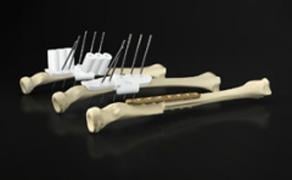
February 15, 2011 – A successful pilot study found the feasibility of using computer-assisted surgical planning and patient-specific surgical guides in correcting lower limb malalignment. In the study, Materialise's SurgiCase Orthopaedics was used to describe lower limb malalignment and virtually plan multi-planar correction using computed tomography (CT) scans.
The trial showed that planned corrections can be obtained and fixed accurately during surgery with the help of Materialise's patient-specific surgical guides. It was conducted by J. Victor, M.D., AZ St. Lucas, Brugge, Belgium.
Despite recent innovations, lower limb malalignment continues to be corrected using traditional methods and techniques, such as relying on 2-D plain X-rays and using rulers and protractors. However, this can be prone to error and, in some cases, inaccurate in multi-planar deformities. The aim of the pilot study was to evaluate the feasibility of virtual pre-operative 3-D planning and correct execution of osteotomies around the knee with the aid of patient-specific surgical guides.
Eight patients presenting with significant malalignment of the lower limb were included in the study (7 valgus, 1 varus knee). Pre-operative CT scans of the affected limbs and the normal contra-lateral side were obtained and sent to Materialise where 3-D models of the patients' anatomy were created. These models made it possible for Victor to carefully evaluate the three-planar deformity of each patient and identify customized surgical corrections.
After creating the virtual surgical plans, the Materialise team - in close collaboration with Victor - continued designing the patient-specific surgical guides used to perform the planar osteotomy and achieve the planned wedge opening and hinge axis orientation. These guides were also used in the drilling of the planned screw holes and thus, determined the position of the plate relative to the bone. Post-operative assessments of the corrections were obtained through AP and lateral X-rays, and full leg standing X-rays.
The results of the study are promising. All of the patient-specific guides were successfully used during surgery and accurately guided the osteotomy plane and screw holes. The guides fit uniquely onto the patients' bones and it was possible to perform the osteotomies through the guides. The predrilled screw holes matched the locking plates and adequate fixations were obtained. No significant peri-operative complications occurred.
For more information: www.materialise.com

 September 09, 2026