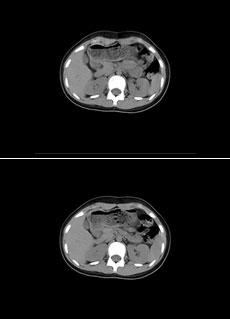
The top image uses a standard dose of 140mA and has not been enhanced. The bottom image uses half the dose (70 mA) and has been post-processed with GOPView CT. The bottom image offers less noise and increased sharpness with 50% of the standard dose.
October 20, 2009 - ContextVision reported it successfully implemented GOPView CT, its CT image enhancement software, on a Cell microprocessor, enabling ContextVision to offer its OEM customers an improved hardware platform for image enhancement, delivering 40 frames per second (fps).
This revolutionary microprocessor, the Cell Broadband Engine Architecture, also known as Cell, was developed through collaboration between Sony Computer Entertainment, Toshiba and IBM. The application's computational performance delivers the highest speeds realized in CT - 40 fps using common filters.
Originally created to increase performance for computer entertainment, wireless downloads, real-time video chat, and other image-intensive modalities, the Cell processor has been used primarily in the gaming industry. The Cell processor serves as the heart of Sony’s Playstation 3.
As modern microprocessors continue to improve, the technology offers an opportunity to develop medical image enhancement capabilities beyond those of current technology. The Cell’s ability to efficiently process floating point data makes it extremely suitable to implement complex algorithms that require high accuracy. Every improvement made in medical imaging enables doctors to work more efficiently with their patients, ultimately leading to faster and more accurate diagnoses.
GOPView CT uses a proprietary and adaptive algorithm, GOP, which enhances CT output images, leading to greater diagnostic confidence. In some implementations, users may use a lower patient dose while maintaining image quality. This type of dose reduction benefits both patents and hospitals. For patients, the low dose translates to less risk without sacrificing image quality or diagnosis accuracy. Hospitals using GOPView CT in this manner will experience decreased wear and tear on X-ray tubes.
For more information: www.contextvision.com

 September 09, 2026