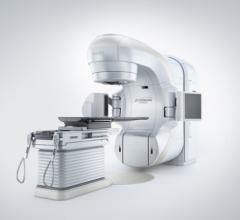
April 21, 2009 – In a study in which researchers from the MD Anderson Cancer Centre Orlando, FL, and the University of Wisconsin, Madison, conducted an analysis of prostate motion during helical tomotherapy, they concluded that the impact on target dose is actually quite small (Int. J. Rad. Oncol. Biol. Phys. doi: 10.1016/j.ijrobp.2008.09.035).
The study marked the first time that helical tomotherapy has been considered in similar detail. Researchers used electromagnetic markers by Calypso Medical Technologies to track prostate motion. Three markers were implanted under ultrasound guidance in 16 patients who went on to receive IMRT. Tomotherapy treatment plans were generated retrospectively and compared with motion tracks from the markers.
Two separate scenarios were considered. The first assumed that treatment started at the beginning of the observation period. The second anticipated an estimated delay of five minutes between patient alignment and the start of treatment. The minimum dose (Dmin), maximum dose (Dmax) and dose to 95 percent of the volume (D95 percent) were calculated for the whole prostate and for the planning target volume (PTV). These values were then compared with the doses that would have been delivered had the prostate stayed still. The cumulative effect was also evaluated over the course of treatment.
The results showed that for individual fractions, target D95 percent could be reduced by as much as 20 percent. However, the effect of such sizeable dose reductions diminished quickly as treatment continued. The effect on target D95 percent was less than 1 percent by the time that five fractions had been delivered. The biggest surprise was the similarity in observed changes to D95 percent for the prostate and the PTV.
While the results only apply to whole-prostate tomotherapy, researchers will test other techniques that may be affected more by organ motion, such as dose-painting, in a follow-up study.
For more information: www.redjournal.org
 October 01, 2026