March 2, 2009 - Women facing a recent breast cancer diagnosis may find additional cancer in the same or opposite breast with further testing using Breast-Specific Gamma Imaging (BSGI) according to a study published in the February 2009 "American Journal of Surgery."
BSGI detected additional or more extensive breast cancer in the same or opposite breast in 10.9 percent of newly diagnosed patients according to the study.
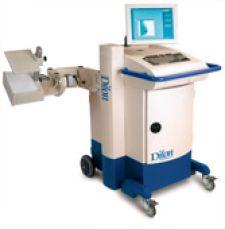
BSGI, a molecular breast imaging technique, is a follow-up to mammography that can see lesions independent of tissue density and discover early stage cancers. With BSGI, the patient receives a pharmaceutical tracing agent that is absorbed by all the cells in the body. Due to their increased rate of metabolic activity, cancerous cells in the breast absorb a greater amount of the tracing agent than normal, healthy cells and generally appear as "hot spots" on the BSGI image. The Dilon 6800 Gamma Camera is a high-resolution, compact field-of-view gamma camera, optimized to perform BSGI.
"The research is important because it helps clarify the role of BSGI in newly diagnosed breast cancer patients,” said Nathalie Johnson, M.D., general surgeon and surgical oncologist at Good Samaritan Hospital, Portland, OR. “We have found that these women can have more extensive disease that is not detected by mammography or ultrasonography. This is especially helpful in patients with dense breast tissue where additional evaluation of the remaining breast tissue is necessary."
Dr. Johnson and her team conducted a retrospective review from two Portland community-based breast imaging centers of newly diagnosed breast cancer patients in whom BSGI was performed as part of the imaging work-up. BSGI detected additional or more extensive malignancy in the same or opposite breast in 10.9 percent of newly diagnosed breast cancer patients. Only 7.2 percent incurred an additional work-up. The study concluded that BSGI provides accurate evaluation of remaining breast tissue in newly diagnosed breast cancer patients with few false-positive readings.
BSGI has comparable sensitivity, but superior specificity when compared to magnetic resonance imaging (MRI), which leads to improved management of the newly diagnosed breast cancer patient. Sensitivity refers to the ability of an imaging technique to detect the presence of disease. Specificity refers to the technique's ability to detect that disease is actually not present.
"The biggest benefit of BSGI is the specificity. The sensitivity of BSGI is on par with MRI, but the specificity is higher than MRI. In addition, when compared to MRI, BSGI is less expensive and easier to use for patient and physician," said Dr. Johnson.
A total of 138 patients (69 invasive ductal carcinoma, 20 invasive lobular carcinoma, 32 ductal carcinoma in situ, and 17 mixtures of invasive ductal carcinoma, invasive lobular carcinoma, or ductal carcinoma in situ and other) were reviewed. Twenty-five patients (18.1 percent) had a positive BSGI study for cancer at a site other than their known cancer, or more extensive disease than was detected from previous imaging. Fifteen patients (10.9 percent) were positive for a synchronous or more extensive cancer in the same or opposite breast. Five patients had benign findings on pathology, five benign on ultrasound follow-up (false-positive rate, 7.2 percent). Findings converted seven patients to mastectomy, one patient to neoadjuvant chemotherapy, and seven patients were found to have previously undetected contralateral cancer. The positive predictive value for BSGI was 92.9 percent.
The full study can be found in “The American Journal of Surgery” (Vol. 197, No 2, February 2009).
For more information: www.dilon.com

 October 19, 2026