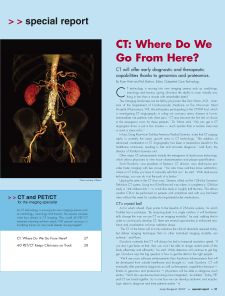
CT technology is moving into new imaging arenas such as cardiology, neurology and trauma, giving clinicians the ability to scan virtually anything in less than a minute with remarkable detail.
The changing landscape can be felt by physicians like Sam Wann, M.D., chairman of the Department of Cardiovascular Medicine at The Wisconsin Heart Hospital (Wauwatosa, WI). He anticipates participating in the CTSTAT trial, which is investigating CT angiography in ruling out coronary artery disease in low-to-intermediate risk patients with chest pain. “CT may become the first test of choice in the emergency room for these patients,” Dr. Wann said. “We can get a CT angiogram done in just a few minutes — much quicker than a nuclear stress test or even a stress echo.”
In fact, Doug Ryan from Toshiba America Medical Systems, notes that CT angiography is currently the major growth area in CT technology. “The addition of advanced visualization in CT angiography has been a tremendous benefit to the healthcare community, resulting in fast and accurate diagnosis,” said Ryan, the director of Toshiba’s business unit.
Other major CT advancements include the emergence of dual-source technology, which allows physicians to view tissue characterization and plaque quantification.
Scott Goodwin, vice president of Siemens’ CT division, says dual-source provides faster imaging with less power. “You also have real-time bone subtraction, where in CT today you have to manually edit that out,” he said. “With dual-source technology, you can do it at the push of a button.”
Upping the ante in the CT slice wars, Siemens rolled out the 128-slice Somatom Definition CT system. Using two 83-millisecond x-ray tubes, it completes a 128-slice study in 164 milliseconds — or a 64-slice study in roughly half the time. This allows cardiac CTA to be performed on patients with arrhythmia and with very fast heart rates without the need for cardiac-slowing beta-blocker medications.
CT’s crystal ball
As for what’s ahead, Ryan points to the benefits of 256-slice systems, for which Toshiba has a prototype. “By acquiring data in a single rotation, it will fundamentally change the way we use CT as an imaging modality,” he said, adding that in order to continuously develop CT, there are several opportunities in enhanced resolution and visualization at lower radiation doses.
“The CT of the future will not only enhance the clinical demands required today, but deliver imaging techniques that no other individual imaging modality can achieve,” said Ryan.
Goodwin contends that CT will always be tied to temporal resolution speed. “If you don’t get faster at that, then you won’t be able to image certain parts of the body effectively and efficiently,” he said. While detectors will continue to get bigger, Goodwin says the big question is how to get the data to the right people.
“We’ll see more software enhancements than hardware enhancements that will be developed from outside healthcare and brought in,” said Goodwin. CT will eventually offer preventive diagnostic as well as therapeutic capabilities because — thanks to genomics and proteomics — physicians will be able to diagnose much earlier. “We’ll also see devices becoming more integrated,” he added. “Today, PET and CT are fused together. So in one box we can develop anatomic and morphologic data to diagnose and treat patients earlier.”

 October 07, 2026