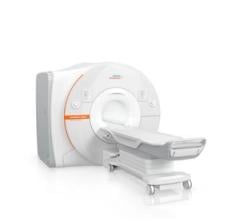
August 21, 2008 - U.S. medical scientists have created a technology that uses magnetic resonance imaging to locate and track specific cells in a living body.
Carnegie Mellon University researcher Eric Ahrens, PhD, developed novel imaging reagents and technology to visualize "with exquisite specificity" cell populations of interest in the living body, officials said.
"With our technology we can image specific cells in real-time with exquisite selectivity, which allows us to track their location and movement and to count the apparent number of cells present. We then use conventional MRI to obtain a high-resolution image that places the labeled cells in their anatomical context," said Ahrens, an associate professor of biological sciences at the Mellon College of Science.
The ability to non-invasively locate and track cells, such as immune cells and stem cells, is expected to be of significance in the study and treatment of cancer, inflammation and autoimmune diseases, as well advancing the emerging field of cellular regenerative medicine.
Ahrens presented his new technology, called fluorocarbon labeling, Thursday in Philadelphia during the national meeting of the American Chemical Society.
Source: UPI.com
For more information: www.upi.com

 November 04, 2026