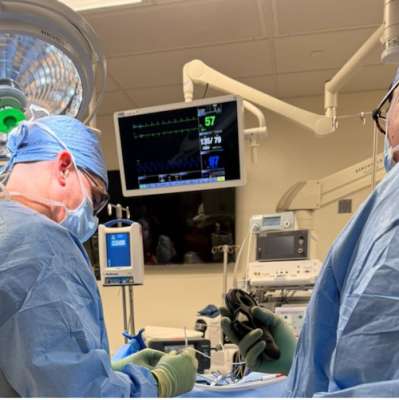
First patient in the world treated with Alpha DaRT in the brain. According to the National Brain Tumor Society, glioblastoma is one of the most complex, deadly, and treatment-resistant cancers, with an estimated average survival rate of only 8 months. (Photo: Alpha Tau Medical)
Dec. 09, 2025 — Alpha Tau Medical Ltd., the developer of the alpha-radiation cancer therapy Alpha DaRT recently announced that the first patient has been treated in its pilot study for the treatment of patients with recurrent glioblastoma multiforme (GBM) using the Alpha DaRT technology.
Uzi Sofer, CEO of Alpha Tau, stated, “This is a historic day for Alpha Tau and for GBM patients around the world, with the first treatment ever of a brain cancer using Alpha DaRT. Given the devastating prognosis of GBM, and its high rate of rapid recurrences, generally within 6-9 months, there is a desperate need for new local therapies with an appropriate safety profile for such a critical and sensitive area like the brain. This pilot study is a key part of our broader strategy to bring Alpha DaRT to cancer patients with some of the highest unmet needs, supported by the FDA’s Breakthrough Device Designation and acceptance into the FDA’s prestigious Total Product Life Cycle Advisory Program designed to accelerate the Alpha DaRT treatment to market and to GBM patients who may stand to benefit greatly.”
The first patient was treated at The Ohio State University Center in Columbus, Ohio, by a multidisciplinary team led by Principal Investigator and Radiation Oncologist Joshua D. Palmer, MD, Medical Physicist Michael Degnan, MS, DABR and Neurosurgeon J. Bradley Elder, MD, using a novel delivery approach designed specifically for intracranial use.
Dr. Joshua Palmer, commented: “Patients with recurrent glioblastoma face one of the most difficult cancer diagnoses in medicine. There is an urgent unmet need for new therapeutic approaches that can be delivered locally while minimizing harm to surrounding healthy brain tissue. Intratumoral alpha-emitting radiotherapeutics such as Alpha DaRT offer a highly compelling novel scientific approach by delivering potent, short-range radiation precisely where it is needed most.”
Dr. J. Bradley Elder, who led the procedure with Dr. Palmer, added: “From a technical standpoint, this procedure demonstrated excellent feasibility. The novel delivery device allowed us to place the Alpha DaRT sources in a precise radial configuration that achieved more than 95% coverage of the tumor volume. Importantly, the system integrates seamlessly as an add-on to the standard brain navigation platform that I use routinely in surgery, making it simple to adopt without disrupting existing workflow.”
“This achievement represents the culmination of many years of dedicated teamwork within Alpha Tau - including extensive preclinical research, developing a unique delivery system designed specifically to integrate seamlessly into a standard neurosurgical workflow and, of course, partnership with our wonderful clinical collaborators at OSU,” commented Dr. Robert Den, Chief Medical Officer of Alpha Tau. “This is a transformational patient-centric moment of great scientific and clinical significance for the entire field of neuro-oncology.”
The clinical trial is expected to enroll up to 10 U.S. patients with recurrent glioblastoma not amenable for surgical resection who have undergone a prior course of central nervous system radiation. The primary objective of the study is to evaluate the feasibility and safety of the treatment, following the company’s promising results from pre-clinical studies.
Additional information about the trial can be found at www.clinicaltrials.gov/study/NCT06910306
 October 01, 2026