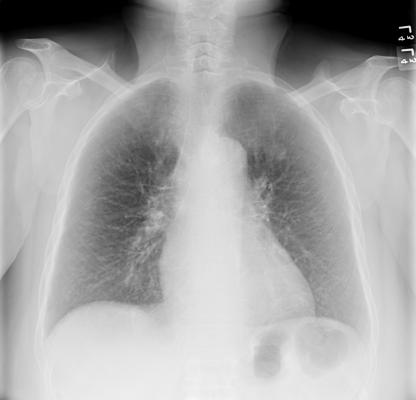
September 14, 2012 — A radiologist’s ability to detect pneumonia early — so it can be treated quickly — is improved by Riverain Technologies software that suppresses the ribs and clavicles on a chest X-ray, suggests new research published online by European Radiology.
Using Riverain’s ClearRead Bone Suppression software, radiologists were more likely to detect small lung opacities representing pneumonia than when reviewed with standard chest X-rays alone of the same patients. An innovative image enhancement technology that can be easily applied to any standard digital chest X-ray, ClearRead Bone Suppression also has been shown to improve the detection of nodules that may be lung cancer.
“The ribs tend to obscure lung abnormalities, particularly when the nodules, or opacities, are very small. This means early focal pneumonia can be overlooked, especially if it happens to lie behind – or even partially behind – a rib,” said co-author Heber MacMahon, MB, BCh, professor of radiology and director of thoracic imaging at the University of Chicago Medical Center. “We demonstrated a real improvement in detection using this bone-suppression software.”
If pneumonia is not detected and treated early it can be deadly, especially in the elderly and those with compromised immune systems due to chemotherapy treatment or other conditions. According to the Centers for Disease Control and Prevention, in 2009 more than 1.1 million people were discharged from the hospital after being treated for pneumonia, and the illness accounted for more than 50,000 deaths.
In the study, eight radiologists (six attending radiologists and two residents) reviewed standard chest X-rays of 36 patients with 46 focal densities due to pneumonia, as well as X-rays of 20 patients who did not have pneumonia. (All cases of pneumonia were confirmed based on CT, surgery or follow-up imaging.) The radiologists then reviewed the same X-rays using ClearRead Bone Suppression. Their observations were scored and compared using the mean value of the area under the receiver operating characteristic (ROC) curve, the standard method for measuring diagnostic accuracy. When the radiologists used only standard chest X-ray, the mean value of the area under the ROC curve was 0.844, which improved to 0.880 with the addition of ClearRead Bone Suppression.
Although seemingly small, the improvement is statistically significant. “Because abnormalities can be obscured by bones, there are opportunities for early pneumonia to be missed,” said MacMahon. “Our research suggests the addition of this software to standard chest X-rays will translate into significant improvement in actual practice.”
“Previous studies have shown this software improves radiologists’ ability to detect subtle abnormalities that may be lung cancer,” said Steve Worrell, Riverain’s chief technology officer. “With pneumonia being more common than lung cancer, this new research shows our software offers an even broader application and benefit to the hospital and patients.”
ClearRead Bone Suppression is less expensive, easier to implement and exposes patients to far less radiation compared to alternative chest imaging methods, such as computed tomography (CT). ClearRead Bone Suppression received 510(k) clearance from the U.S. Food and Drug Administration (FDA) for the detection of lung nodules, and can be used with any X-ray system.
For more information: www.riveraintechnologies.com

 October 07, 2026