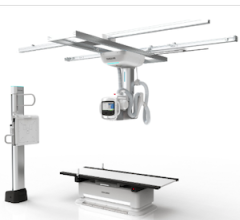
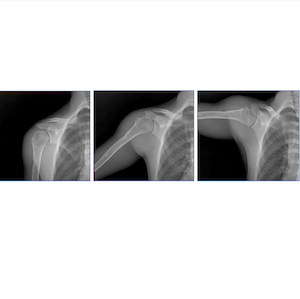
Photo: Emory Healthcare/Konica Minolta
Nov. 10, 2026 — Konica Minolta Healthcare Americas recently congratulated Emory Healthcare researchers, led by Eric R. Wagner, MD, MS, and Sameer Khawaja, MD, of Baylor College of Medicine, on the publication of their study, “Total Shoulder Arthroplasty and Scapulohumeral Rhythm: The clinical impact of achieving native shoulder mechanics,” published in the Journal of Shoulder and Elbow Surgery.
Their research examined the impact of scapulohumeral rhythm (SHR) in pre- and post-arthroplasty shoulders on patient outcomes. The assessment of SHR in a large cohort of patients in routine care was enabled by Dynamic Digital Radiography (DDR). The study demonstrates that SHR measured from DDR images can be used to directly assess shoulder kinematics and predict clinical outcomes, as patients with higher SHR (lower scapular compensation) were associated with higher patient-reported outcome measures at three years postoperative.
Dynamic Digital Radiography
The study uses a DDR imaging and measurement process previously reported by Khawaja, et al (2026). Eighty-five postoperative shoulder patients were enrolled, consisting of 27 anatomic total shoulder arthroplasties (aTSA) and 58 reverse total shoulder arthroplasties (rTSA). The authors report that lower SHR, which is associated with greater scapular compensation, is associated with worse postoperative outcomes, including pain and subjective shoulder function. Their findings suggest incorporating DDR into clinical practice to measure SHR and assess scapular motion “may facilitate targeted rehabilitation, postoperative surveillance, and continue to improve outcomes by reproducing native mechanics after TSA.”
“These findings underscore the potential value of DDR measures, such as SHR, in assessing function and integrating such parameters into preoperative planning and postoperative monitoring. DDR enables us to visualize actual shoulder kinematics during movement and provides a validated, reliable assessment of in vivo SHR within a busy clinical environment,” says Dr. Wagner.
“Prior to DDR, in-vivo shoulder kinematics was not possible to assess in a clinical setting, previously reserved for the laboratory setting exclusively. In our clinic, every shoulder patient now receives a DDR evaluation before and after intervention, as we have found the information it provides for pre-surgical planning and post-operative monitoring is invaluable for helping to improve patient outcomes,” adds Dr. Khawaja.
Dr. Wagner and colleagues have studied the use of DDR to measure SHR in several published studies. Most recently, their study in JSES International reported that DDR is a valid, reliable method for SHR measurement similar to advanced 3D modeling imaging techniques that are often resource-restricted and time-consuming.1 Further, 3D-to-2D techniques are resource-intensive for measurements and may be feasible only in research settings. The authors state that DDR may help bridge this gap by acquiring “the most clinically useful information in a practical and efficient manner,” and that the imaging exam can be performed in an outpatient setting using the same equipment as conventional static X-rays.
“With this research, Drs. Wagner, Khawaja and team have been able to use DDR to assess SHR and thus directly measure the impact of mechanical function on patient outcomes in shoulder arthroplasty. DDR is the first technology that enables efficient measurement of SHR in the routine clinical setting. DDR facilitates incorporation of this metric, established in research settings, to be used in the standard-of-care monitoring and improvement of patient outcomes,” says John Sabol, PhD, Clinical Research Manager at Konica Minolta Healthcare.


 November 13, 2026