Sept. 8, 2025 — Pathology plays a crucial role in the diagnosis of a variety of diseases, particularly cancer, through examination of patient tissue samples. With an estimated 70% of important medical decisions involving laboratory or pathology tests2, the availability of digitally stored pathology images is especially important as it has a significant impact on patient care. The digital transformation of pathology also means there is a growing need for scalable storage to meet new data volumes and computing resources, which also allows full AI adoption in clinical and research environments.
DICOM (Digital Imaging and Communications in Medicine) is the international standard for medical images and related patient information. Because digital pathology is a relatively new imaging modality compared to radiology and others, there was no established DICOM standard in place. As a result, vendors created their own proprietary formats.
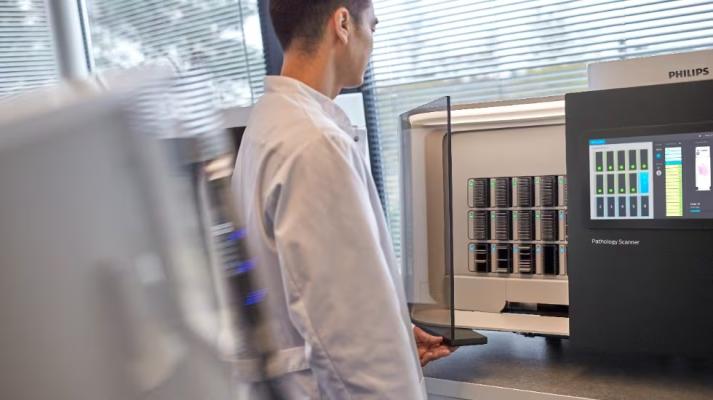
Philips announced that it is expanding its SG300 and SG60 scanner offering with the Pathology Scanner SGi with configurable DICOM JPEG and DICOM JPEG XL output. As a result, it is the first icompany to offer native DICOM JPEG XL output. DICOM JPEG XL output files are up to 50% smaller while still providing the same high image quality3, enabling pathology labs to store, manage, and analyze growing volumes of digital pathology data and enable more productive workflows in the cloud and on premise.
“The adoption of DICOM in pathology marks an important shift toward achieving scalable, interoperable imaging workflows, said Imogen Fitt, Principal Analyst at Signify Research. “As pathology labs face mounting data volumes and storage demands, the move to standardized formats helps reduce infrastructure costs and enables integration with a wider range of AI tools. Philips’ support for DICOM JPEG and DICOM JPEG XL as a native output from its scanners illustrates how vendors are aligning with these trends, intending to support capabilities such as centralized archiving, cross-modality diagnostics, and remote collaboration for customers.”
“As a leader in digital pathology, Philips is innovating digital pathology workflows that scale efficiently, integrate seamlessly and reduce storage costs,” said Martijn Hartjes, Business Leader Clinical Informatics at Philips. “We want to ensure our customers are realizing benefits today while being future-ready – with solutions that are flexible, interoperable, and scalable – so they can deliver better care to more people.”
In addition, the DICOM standard eases collaboration between pathology and other imaging modalities, scaling cross-modality integrated diagnostics and decision-making, as well as consolidation of IT infrastructure through the archiving of both radiology and pathology images in a single location and archive (a PACS or vendor-neutral archive).
Philips’ digital pathology solution includes whole-slide scanners, image management system, and proven implementation and support services to guide the transformation from analog to fully digital pathology workflows. With the use of AI-powered tools in digital pathology, labs will become more efficient and effective, addressing the pressure of a global shortage of pathologists and the growing number of cancer patients.
References
1. Pathology Scanner SGi is under development and is not CE marked and is not yet available for sale.
2. Report of the Second Phase of the Review of NHS Pathology Services in England, Lord Carter of Coles (2008). Results are specific to the institution where they were obtained and may not reflect the results achievable at other institutions.
3. Based on preliminary test data on diverse slide types. Data representative of a typical clinical mix is not yet available.
 October 02, 2026