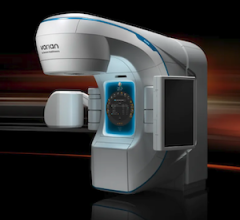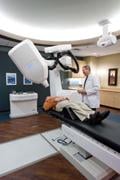
Accuray's Cyberknife
March 14, 2011 – Two of the most advanced tools for precise radiotherapy-based treatment are now under one roof in Seattle. Swedish Medical Center this month became the first facility in the Pacific Northwest – and one of only a handful in North America – to open a unit that incorporates both CyberKnife and Gamma Knife technologies.
The Center recently installed the latest model Leksell Gamma Knife, made by Elekta. It complements the Accuray CyberKnife, which has been operational for five years and been used on approximately 1,000 patients. The team at the Swedish Neuroscience Institute has joined forces with oncologists at the Swedish Cancer Institute to provide a broad range of experience and expertise.
"Having both Gamma Knife and CyberKnife at a single facility allows surgeons, radiation oncologists and physicists to select the very best treatment modality for every patient," said Marc Mayberg, M.D., co-director of the Swedish Neuroscience Institute. "Frequently, minimally invasive surgical procedures can be combined with radiosurgery to provide highly effective therapies that are associated with minimal risk and minimal disruption to the patient's life and work."
"The Radiosurgery Center is another example in a long history of innovation by radiation oncologists here," said Vivek Mehta, M.D., a radiation oncologist with Swedish Cancer Institute. "By arming physicians with state-of-the-art technologies and putting them under one umbrella, patients can be assured they will be treated with the best equipment by clinicians with special expertise."
Gamma Knife surgery, a form of stereotactic radiosurgery, is a noninvasive method for treating brain disorders. It involves the delivery of a single, high dose of radiation to an intracranial target in the skull to kill cancer cells and shrink tumors. Its extreme precision makes it possible to administer a high radiation dose to the diseased area, minimizing the risk of damaging adjacent healthy tissue.
"The key to the success of the Gamma Knife is its ability to accurately focus many beams of high-intensity gamma radiation to converge on one or more tumors," said neurosurgeon Ronald Young, M.D. "Each individual beam is relatively low energy, so the radiation has virtually no affect on healthy brain tissue."
The technology is used for a variety of neurological disorders – including blood vessel abnormalities in the brain, benign brain tumors, cancerous brain tumors and painful conditions, such as trigeminal neuralgia. Young also expects to use the system to treat essential tremor. Research is being conducted on other possible uses, such as treating in epilepsy, Parkinson's disease and melanoma of the eye.
The surgery avoids surgically opening the skull, which has obvious advantages for the patient's quality of life, treatment cost, clinical outcomes and reduction of complications. The procedure is completed in a shorter time frame, and patients generally go home within a few hours, resuming normal activities within a few days. Side effects of treatment are usually minimal. Some patients experience a mild headache, but there is no loss of hair or nausea, as with some cancer treatments. The procedure is covered by most insurance plans.
It is uniquely well suited to treat tumors that have metastasized to the brain from other areas. It is particularly effective on tumors smaller than 3.5cm in diameter and with patients who have multiple lesions. The system is highly flexible and, if need be, the treating physicians are often able to treat numerous tumors in the brain in one setting. Research studies have shown that local control – meaning the specific tumor treated does not come back – exceeds an average of 85 percent for the management of tumors in any brain location.
CyberKnife, like Gamma Knife, is a stereotactic technology, which in addition to the brain can treat tumors in other parts of the body, including the spine, lung, prostate, liver and pancreas. It, too, is incredibly precise and can track moving targets accurately within 1 to 2 millimeters. Plus, it has built-in motion correction capability in case a patient moves during treatment.
Radiation oncologist Sandra Vermeulen, M.D., recently began using it to treat women with early-stage breast cancer whose sentinel nodes are clear.
"Some traditional radiation treatments deliver dose to adjacent normal tissue in order to cover the cancer risk area. This added volume of normal tissue can sometimes result in unpleasant side effects. With CyberKnife, the normal tissue can be better excluded from the high-dose regions, resulting in fewer side effects," she said.
For more information: www.swedish.org

 October 09, 2026