News | Radiology Imaging | December 04, 2020

GE Healthcare's prototype 16-channel head Adaptive Image Receive (AIR) radiofrequency coil outperformed a conventional 8-channel head coil for in vivo whole-brain imaging

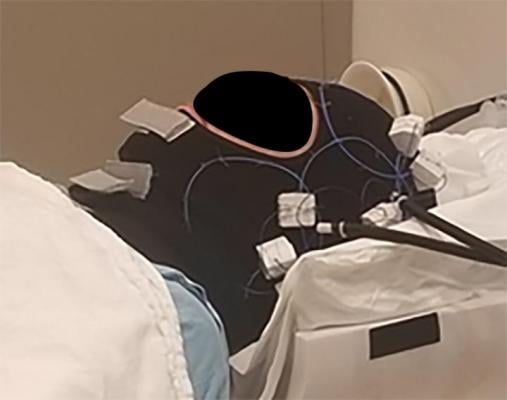
In this prototype design, no elements are placed over patient's eyes, nose, or mouth, which may improve comfort compared with conventional coils. In this image, identifiable portions of participant's face have been obscured for publication and privacy purposes. Image courtesy of the American Roentgen Ray Society (ARRS), American Journal of Roentgenology (AJR)

In this prototype design, no elements are placed over patient's eyes, nose, or mouth, which may improve comfort compared with conventional coils. In this image, identifiable portions of participant's face have been obscured for publication and privacy purposes. Image courtesy of the American Roentgen Ray Society (ARRS), American Journal of Roentgenology (AJR)


December 4, 2020 — According to an article in ARRS' American Journal of Roentgenology (AJR), a prototype 16-channel head Adaptive Image Receive (AIR) radiofrequency coil from GE Healthcare outperformed a conventional 8-channel head coil for in vivo whole-brain imaging, though it did not perform as well as a conventional 32-channel head coil.

"This study shows the feasibility of the novel AIR coil technology for imaging the brain and provides insight for future coil design improvements," concluded first author Petrice M. Cogswell, M.D., Ph.D., of the Mayo Clinic in Rochester, Minnesota.

Lightweight and flexible with an open, ski-mask design, the emergent AIR coil technology exhibits electrical characteristics that overcome several of the limitations of traditional rigid coil designs.

Imaging a phantom and 15 healthy adult participants, Cogswell and colleagues used clinically available MRI sequences to compare their 16-channel head AIR coil with conventional 8- and 32-channel head coils. During consensus review, two board-certified neuroradiologists graded the AIR coil against the 8-channel coil and the 32-channel coil on a 5-point ordinal scale in multiple categories.

On average, the signal-to-noise ratio, structural sharpness, and overall image quality scores of the 16-channel AIR coil prototype were better than those of the 8-channel coil but not as good as those of the 32-channel coil.

Noise covariance matrices showed stable performance of the AIR coil across participants. Overall, the median g-factors for the 16-channel AIR coil were less than those of the 8-channel coil but greater than those of the 32-channel coil.

"The advantages of the AIR coil technology for reduction of claustrophobia, improved airway access and monitoring of patients under anesthesia, and overall better user comfort may be investigated in future studies," the authors of this AJR article added.

For more information: www.arrs.org

Related Content

News | Interventional Radiology

Dec. 1, 2025 — GE HealthCare has unveiled the Allia Moveo,1 an image guiding solution designed to enhance mobility and ...

Time December 02, 2025
arrow
News | Archive Cloud Storage

Nov. 30, 2025 — Gradient Health, Inc. has released Atlas 2, a major upgrade to its self-service medical imaging data ...

Time December 01, 2025
arrow
News | Artificial Intelligence

Nov. 24, 2025 — Siemens Healthineers is launching artificial intelligence-enabled services to help healthcare providers ...

Time November 24, 2025
arrow
News | Artificial Intelligence

Nov. 20, 2025 — Aidoc has announced a collaboration with AdventHealth to launch one of the largest imaging AI ...

Time November 21, 2025
arrow
News | Radiology Business

Nov. 13, 2025 — Covera Health recently announced that Advanced Radiology Services (ARS) has joined its national Quality ...

Time November 17, 2025
arrow
News | Radiology Business

Nov. 12, 2025 — Siemens has announced plans to deconsolidate its remaining stake in Siemens Healthineers (currently ...

Time November 13, 2025
arrow
News | Orthopedic Imaging

Nov.10, 2025 — Medical imaging technology company Adaptix Ltd. has received 510(k) clearance from the U.S. Food and Drug ...

Time November 11, 2025
arrow
News | Magnetic Resonance Imaging (MRI)

Nov. 10, 2025 — There has been substantial progress in the past few years in the field of MRI in general and remote MR ...

Time November 11, 2025
arrow
News | Contrast Media

Nov. 10, 2025 — Scientists at the University of Birmingham have developed a new class of MRI contrast agents – improving ...

Time November 10, 2025
arrow
News | X-Ray

Oct. 30, 2025 – In collaboration with OBIO, University Health Network (UHN), Canada’s leading hospital and the No. 1 ...

Time November 03, 2025
arrow
Subscribe Now