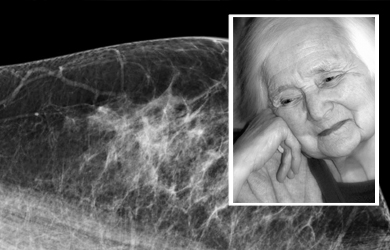
August 14, 2014 — Mammography-detected breast cancer is associated with a shift to earlier stage diagnosis in older women, subsequently reducing the rate of more advanced, difficult-to-treat cases, according to a new study published online in the journal Radiology. Researchers said the findings lend support to regular mammography screening in women ages 75 and older.
The value of mammography screening in older women has been subject to much debate in recent years. The American Cancer Society recommends annual mammograms for women age 75 and older as long as they are in good health, while the U.S. Preventive Services Task Force (USPSTF) does not recommend mammography screening in this age group, citing insufficient evidence to evaluate benefits and harms.
A lack of research is chiefly responsible for the divergent recommendations, according to Judith A. Malmgren, Ph.D., affiliate assistant professor at the University of Washington’s School of Public Health and Community Medicine in Seattle. “There are no studies on women age 75 and older, despite the fact that they are at the highest risk for breast cancer,” she said.
Malmgren and her research partner, Henry Kaplan, M.D., from the Swedish Cancer Institute in Seattle, recently looked at the impact of mammography detection on older women by studying data from an institutional registry that includes more than 14,000 breast cancer cases with 1,600 patients over age 75.
The majority of mammography-detected cases were early stage, while physician- and patient-detected cancers were more likely to be advanced stage disease. Mammography-detected invasive breast cancer patients were more often treated with lumpectomy and radiation and had fewer mastectomies and less chemotherapy than patient- or physician-detected cases.
Mammography detection was associated with a 97 percent five-year disease-specific invasive cancer survival rate, compared with 87 percent for patient- or physician-detected invasive cancers.
“Mammography enables detection when breast cancer is at an early stage and is easier to treat with more tolerable options,” Malmgren said. “In this study, older women with mammography-detected invasive cancer had a 10 percent reduction in breast cancer disease-specific mortality after five years.”
The early detection provided by mammography is particularly important in older women, Malmgren noted, because they cannot easily tolerate the chemotherapy that is commonly used to treat more advanced breast cancers. “Longer life expectancies for women also increase the importance of early detection,” she said. “A 75-year-old woman today has a 13-year life expectancy. You only need five years of life expectancy to make mammography screening worthwhile.”
Malmgren acknowledged the potential costs of mammography, such as those associated with false-positive results, are an important consideration when weighing screening benefits. However, she said that false-positive findings are less common in older women.
“It’s easy to detect a cancer earlier in older women because breast density is not an issue,” Malmgren said. “And mammography is not expensive, so doing it every other year would not add a lot of cost to healthcare.”
The researchers hope the study results help women and their physicians make better-informed decisions about mammography, ultimately leading to lower mortality rates. “Breast cancer survival in younger women has improved dramatically over last 20 years, but that improvement has not been seen in older women,” Malmgren concluded.
For more information: www.radiology.rsna.org
 October 09, 2026