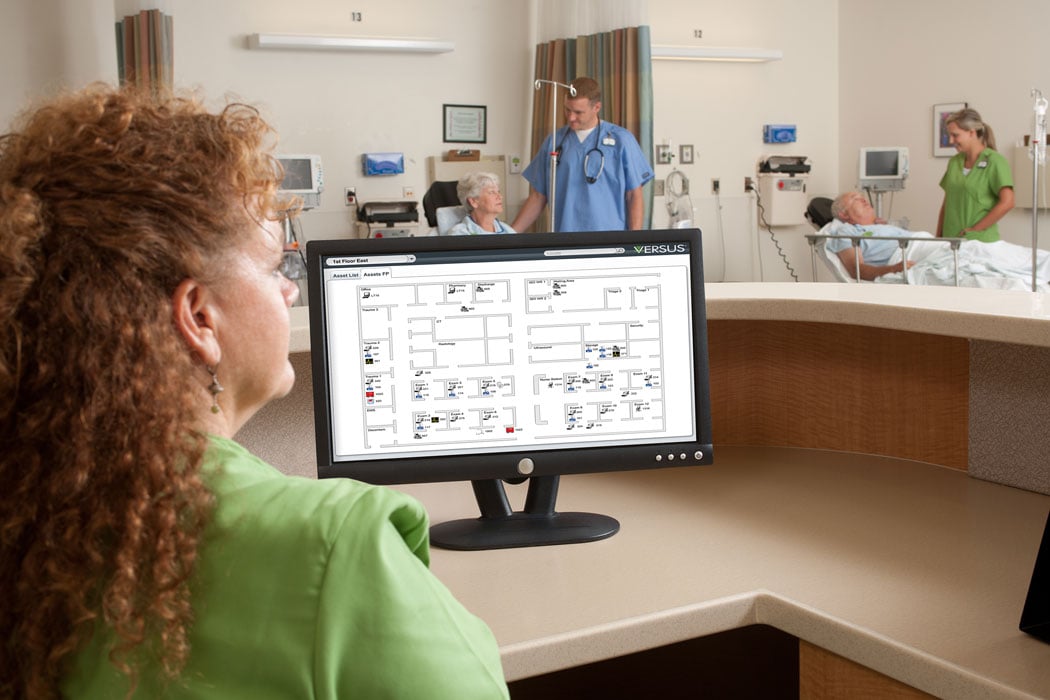
Real-time location systems can quickly localize medical equipment, showing on-screen their location, availability and the attending staff. (Photo courtesy of Versus)
The transition from film to flat panel has dramatically improved the efficiency of portable X-ray units. Transmitting images directly to viewing stations and PACS has streamlined operations by eliminating the need to return these systems to a home base for image processing. But this freedom has created inefficiencies of its own.
Digital radiography (DR) units can be just about anywhere. They may be functioning as they should — or not. And staff may or may not be nearby.
In search of these wayward systems, their status and their operators, the radiology department at Johns Hopkins Hospital tried several solutions. They tried calling techs verbally; setting up whiteboards for them to sign machines in and out; even posting sticky notes. None worked, at least not well. Then came RadLocator, a Web-based system that updates the location and status of portable DR systems in real time.
In RadLocator, infrared sensors and radiofrequency tags are installed on portable DRs and embedded in personnel badges. These sensors feed raw data into the system, which calculates locations and merges them into Hopkins’ radiology information system (RIS). Techs also signal the availability of their machines. They may be “in use,” “available” or “temporarily available,” for example, due to an unexpected pause in a scheduled exam. Or they may be “out of order” and in need of repair.
RadLocator records and then displays the location of staff and portable DRs on a list or diagram. It color codes the status of the machines. It even indicates the date and time each is moved from one place to another.
According to Hopkins staff, who reported in May on its use at a Society for Imaging Informatics in Medicine (SIIM) 2015 session, RadLocator serves as both a “situational awareness tool and a communication tool.” The Hopkins team concluded that the system “decreases the wasted time required for staff members to locate portable DR machines … and allows technologists (to) make informed decisions regarding utilization.”
Efficiency Takes Over
RadLocator — and systems like it — may be coming into vogue, as the transition from fee-for-service reimbursement to pay-for-performance puts a premium on efficiency. Real-time location systems (RTLS) offer hospitals a way to make the most of their equipment and staff — and not just in radiology. Administrators have used RTLS to identify bottlenecks and improve workflow for a range of medical devices. Savings have accrued through fewer equipment purchases, reduced labor costs and more uptime achieved with better maintenance.
The potential in radiology is particularly huge. About 13,000 portable X-ray units are operating in the United States at some 4,200 radiology departments, according to a 2010 survey conducted by IMV Medical Information Division. Many, if not most of these units, are digital.
Several companies offer products that could be used to track them. Versus Technology, which provides the tracking technology used at Johns Hopkins, offers its Advantages Asset Management system. GE’s AgileTrac can be customized to track medical devices. Agfa two years ago unveiled a radio frequency identification (RFID)-enabled tracking system for locating medical devices and staff.
Not Always a Solution
Although appealing and available, RTLS may not be the answer in all settings. Infrared and radiofrequency ID technologies can interfere with medical equipment, just as the operation of medical equipment may prevent RTLS from operating correctly. Radio waves from medical equipment, for example, can degrade RTLS signals, as can metals, water and even people.
Then there is the human factor. In a particularly epic fail in 2001, a RTLS designed to track nurses in the new wing of a London Hospital never got off the ground. Nurses refused to wear their ID badges.
Winning the acceptance of staff, who may be concerned about privacy, is no less important than ensuring that the tracking technology is suited to the environment in which it will operate. Contracts must be written to ensure that the selected system meets the operational goals of the hospital and department — not just “functional specifications.”
These caveats aside, the savings possible through real-time asset management remain one of radiology’s widely untapped potentials.
Greg Freiherr has reported on developments in radiology since 1983. He runs the consulting service, The Freiherr Group. Read more of his views on his blog at www.itnonline.com.

 October 08, 2026