
Derek L. Nguyen, MD
Duke University School of Medicine
March 13, 2025 — According to research published in the American Journal of Roentgenology (AJR), imaging surveillance may be a safe alternative to surgical excision for architectural distortions (ADs) detected by digital breast tomosynthesis (DBT) alone with no sonographic correlate showing benign pathology without atypia on core needle biopsy (CNB).
“The malignancy rate was 0% for ADs without atypia, versus 20% for ADs with atypia, on CNB,” explained first author Derek L. Nguyen, MD, from the radiology department at Duke University School of Medicine in Durham, NC.
Dr. Nguyen and colleagues’ AJR accepted manuscript included patients with ADs detected by DBT alone with no ultrasound correlate and nonmalignant results on stereotactic CNB with 12 vacuum-assisted 9-gauge cores from July 1, 2020, to December 31, 2023. ADs detected by DBT alone with no ultrasound correlate showing concordant benign pathology or radial scar without atypia on CNB were recommended to undergo 6-month and 12-month diagnostic imaging follow-up before returning to annual screening, whereas those showing atypia (with or without radial scar) on CNB were recommended to undergo surgical excision; however, patients could electively undergo the alternative management option. Nguyen et al. then assessed malignancy rates, considering ADs to be nonmalignant based on results of repeat CNB, surgical excision, or 12-month diagnostic imaging follow-up.
Ultimately, for ADs detected by DBT alone with no ultrasound correlate and nonmalignant results on CNB obtaining 12 vacuum-assisted 9-gauge samples, malignancy rates were 0% (0/94) in the absence of atypia (with or without radial scar), versus 20% (3/15) in the presence of atypia (with or without radial scar), on CNB.
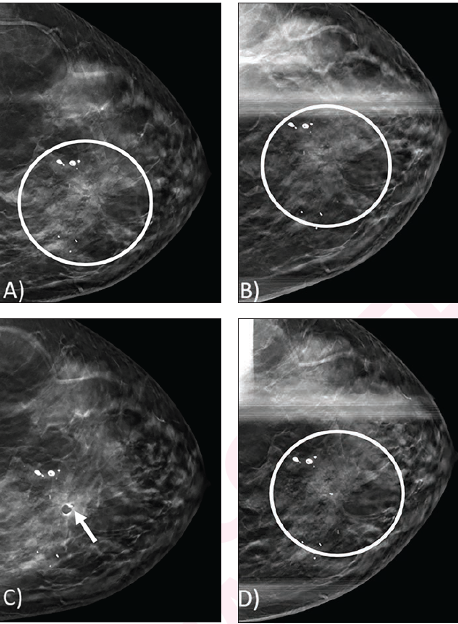
54-year-old woman undergoing breast cancer screening

 October 30, 2026