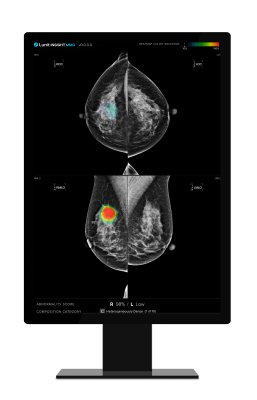
Oct. 23 , 2024 — Lunit recently announced the findings from two large-scale studies evaluating its AI-powered mammography solution, Lunit INSIGHT MMG. The studies conducted by researchers at the Cancer Registry of Norway and Odense University Hospital in Denmark demonstrate the technology's potential to significantly improve breast cancer screening programs.
The Norwegian study, published in JAMA Network Open, led by Professor Solveig Hofvind, evaluated how Lunit INSIGHT MMG could estimate the development of future cancer. The research analyzed data from 116,495 women aged 50-69 who underwent at least three consecutive biennial screening rounds at nine breast centers in Norway. The research found that Lunit INSIGHT MMG can estimate future breast cancer risk up to 4 to 6 years before it becomes detectable.
Lunit's AI assigns each breast a score from 0 to 100, with higher values indicating a greater likelihood of cancer being present on the current mammogram. The study found that the mean AI scores were consistently higher for breasts that developed cancer compared to those that remained cancer-free, even 4 to 6 years before detection. Over multiple screening rounds, the gap in these AI scores between breasts that developed cancer and those that did not grew larger, indicating the AI’s ability to detect subtle signs of cancer earlier.
Specifically, for women who developed screen-detected cancer, the mean absolute differences in AI scores between the two breasts were 21.3 in the first study round, 30.7 in the second, and 79.0 in the third. Additionally, Lunit's AI achieved an Area Under the Curve (AUC) for the absolute difference of 0.63, 0.72, and 0.96 across the three screening rounds for screen-detected cancer. These findings indicate that Lunit's AI can effectively identify early signs of cancer and offer a pathway for personalized screening approaches.
The double reading of mammograms, though the standard of care in Denmark and other European regions, is resource-intensive and demands significant radiologist time. The Danish study, led by Dr. Mohammad T. Elhakim and published in Radiology: Artificial Intelligence, explored how Lunit INSIGHT MMG could enhance double reading without compromising screening performance. The research team evaluated three AI-integrated screening scenarios on 249,402 mammograms, demonstrating significant reductions in radiologist workload while either maintaining or improving accuracy (Scenario 1: AI replaced first reader; Scenario 2: AI replaced second reader; Scenario 3: AI replaced both for triaging of low and high-risk cases).
Results showed that replacing the first, second, or both radiologists with Lunit's AI could reduce reading volume by 48.8%, 48.7%, and 49.7%, respectively, while maintaining or improving cancer detection accuracy. Most notably, the AI triage scenario (Scenario 3) achieved higher sensitivity, positive and negative predictive values with a lower arbitration rate when compared to standard double reading. This result highlights that by utilizing Lunit INSIGHT MMG, healthcare systems can significantly reduce radiologists’ burden without compromising the screening program’s diagnostic performance quality, allowing them to focus on more complex cases and improving overall efficiency.
Additional information is available at lunit.io
 September 30, 2026