The global ultrasound devices market size was estimated at $9.79 billion in 2023 and is anticipated to expand at a compound annual growth rate (CAGR) of 4.24% from 2024 to 2030, according to Grand View Research. Its latest analysis, “Ultrasound Devices: Market Size, Share & Trends Analysis Report: 2024-2030” forecasted the market’s growth is being driven by the rising usage of ultrasound equipment for diagnostic imaging and treatment, along with the increasing prevalence of chronic and lifestyle disorders. Increased demand for minimally invasive surgeries and frequent developments in ultrasound imaging technology continue to influence market growth, as was clear to see throughout the past year and during RSNA 2023.
View the Ultrasound Systems Comparison Chart here
North America dominated the market and accounted for the largest revenue share of over 29.75% in 2023. The region is expected to grow at a significant rate from 2024 to 2030. The Grand View Research analysis further noted that growing number of competitors, increasing cancer cases, increasing expenditure on healthcare, and favorable policies for reimbursement are projected to drive regional market growth.
The diagnostic ultrasound devices segment accounted for the largest revenue share of more than 84.27% in 2023, driven mainly by applications in obstetrics, cardiology and oncology. Higher demand for diagnostic ultrasound devices will increase, they purport, due to technological improvements and rising prevalence of various lifestyle-related diseases. The report further noted regulatory approvals of ultrasound devices are the main driver of the segment's growth.
The therapeutic ultrasound devices segment is estimated to register a CAGR of 4.9% from 2024 to 2030. This segment is further divided into high-intensity focused ultrasound and extracorporeal shockwave lithotripsy. The analysis noted the high-intensity focused ultrasound segment held the largest revenue share in 2023 and is expected to grow significantly over the forecast period since these devices are highly effective in treating cancers and other related disorders. For instance, according to the American Cancer Society Journals, in 2023 alone, 1,958,310 new cancer cases and 609,820 cancer deaths are projected to occur in the U.S. The cart/trolley-based ultrasound devices segment accounted for the largest revenue share of over 67.75% in 2023.
The handheld ultrasound devices segment is anticipated to register the fastest growth rate of 5.73% from 2024 to 2030. Handheld devices are in high demand due to the growing trend of home healthcare and remote patient monitoring.
U.S. Market Players Launch Plethora of New Products
The United States Ultrasound Devices Market size is estimated at $2.95 billion in 2024, and is expected to reach $3.86 billion by 2029, growing at a CAGR of 5.48% during the forecast period (2024-2029).
The major factors fueling the growth of the segment are innovative product launches, technological advancements, and the growing adoption of ultrasound devices, according to Mordor Intelligence, which referred to ultrasound as a fundamental component driving healthcare.
Users continue to be challenged with overwhelming patient volume, and staffing shortages, along with more complex cases, all of which create a trifecta of concerns which industry vendors are working aggressively to address. The large number of new product introductions in the past year alone reflect the struggles and opportunities.
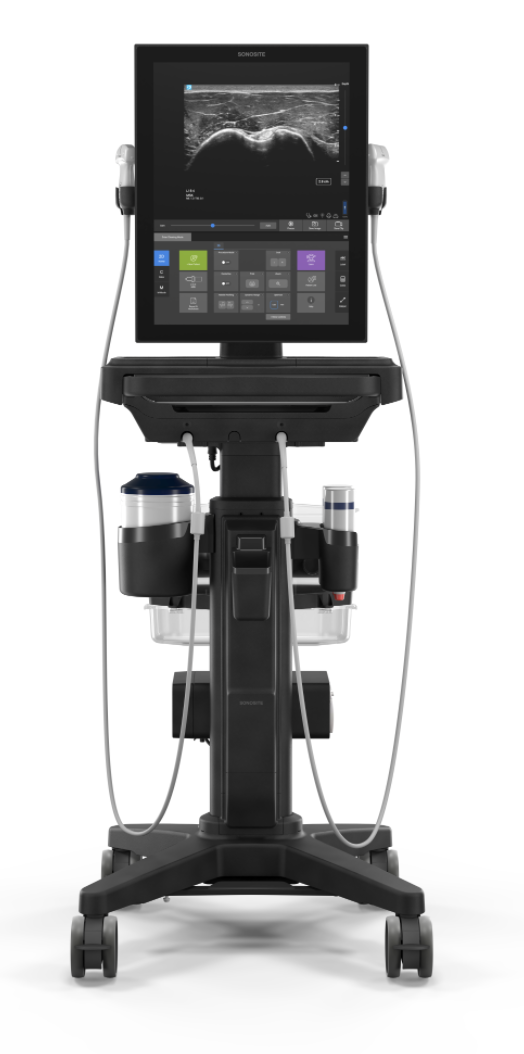
In July, 2023, Fujifilm introduced the Sonosite ST system designed and engineered to support procedural workflow “with the busy proceduralist in mind.” This point-of-care ultrasound system (POCUS) offers a new 21-inch all-touchscreen interface, a large 10” by 7.5” image area, automated setting optimization for each exam type, Auto Steep Needle Profiling (SNP), among other features. The company reports it shares the same family of transducers with Sonosite PX and Sonosite LX to support compatibility across systems.
GE HealthCare launched an enhanced venue family POCUS system featuring AI-driven caption guidance in October, 2023. Caption Guidance is an optional add-on that offers new capabilities at the point of care, supporting clinicians in a wide range of clinical settings and practices such as emergency departments, critical care wards, and anesthesiology. This AI-powered technology will, according to the company, expand access to scans by enabling a broader set of healthcare providers to perform cardiac exams with real-time guidance at the point of care. The company reported that the Venue Family is the first among GE HealthCare ultrasound products to incorporate this scan guidance technology following the company’s acquisition of Caption Health earlier this year.
During RSNA 2023, Royal Philips launched its next generation ultrasound systems EPIQ Elite and Affiniti. The systems feature new automated tools and a common user interface coupled with transducer compatibility across Philips ultrasound systems, including the recently introduced Compact Ultrasound 5000 Series. These latest advances, reports the company, are demonstrating a positive impact on patient and staff satisfaction with customers worldwide — by helping to improve workflow and provide greater scanning efficiency.
Additonally, Siemens Healthineers introduced its ACUSON Maple Ultrasound System just ahead of RSNA in Nov. 2023. Designed for versatility, it supports 15 transducers, offers 25 advanced features that enhance usability and streamline workflow. An integrated battery enables up to 75 minutes of unplugged system scanning. The system’s suite of AI-powered tools empowers clinicians to optimize efficiency by increasing consistency in repetitive tasks, while offering a cost-effective system configurable in all clinical settings, for users of all skill levels, allowing rapid diagnosis and assessment.
 October 19, 2026