February 28, 2024 — Royal Philips, a global leader in health technology, today announced a significant milestone as it expands access to virtually helium-free [1] MRI to more patients in more places, with more than 1,000 systems now installed worldwide. As healthcare providers strive to deliver high-quality care to patients, at #ECR2024 Philips is partnering with its customers to improve productivity and access to more sustainable healthcare.
Philips BlueSeal magnet is the industry's first 1.5T fully sealed magnet and requires only 0.5% of the helium of a conventional Philips MR system. By dramatically easing installation requirements and addressing helium scarcity, the Philips BlueSeal 1.5T magnet is helping more patients in diverse locations benefit from a technology that plays an essential role in diagnosing many of the world’s most prevalent diseases.
Philips BlueSeal technology is expanding the reach of MRI to places where it was previously too difficult to install and maintain, including remote and isolated locations, and those prone to tropical storms, earthquakes, and other geographical obstacles. With a magnet that’s 900kg lighter than a traditional system [2] and doesn’t require a quench pipe – required for traditional MR systems to safely expel their large volume of helium out of a building quickly in case of an emergency – Philips MR systems equipped with BlueSeal magnets can be installed in places that were previously unthinkable.
“We wanted to set up the MRI in the basement of a building in the middle of the city center to provide better access to care for our patients. Not having a quench pipe to expel helium out of the building in the event of an emergency was very important to us due to the location of the MRI system,” said Hiroyuki Sugaya, M.D., President, Tokyo Sports & Orthopedic Clinic, Tokyo, Japan. “We also needed an MRI system that would be a good financial investment, significantly reducing construction costs and reducing the need to refill helium.”
Since the first installations in 2018, Philips’ BlueSeal magnet has proven to be reliable technology that is rapidly reshaping patient access to MRI worldwide. Patients on remote island areas in Indonesia and Thailand, as well those in areas at risk of earthquakes and volcanoes in Iceland and Japan, are already benefiting from the technology.
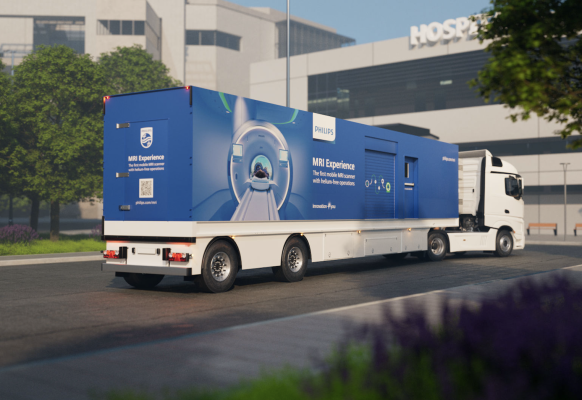
Philips is now bringing its innovation in virtually helium-free MRI to a mobile truck, with the first BlueSeal MR mobile unit [3] developed in Europe for Denmark-based Agito Medical Imaging making its debut at #ECR2024. MR systems equipped with Philips’ BlueSeal magnet technology have saved more than 1.9 million liters of helium since 2018 [4].
“The rapid global adoption of our virtually helium-free MR technology is a strong example of how we are improving the lives of patients, expanding access to cutting-edge imaging technology,” said Ruud Zwerink, Business Leader of MR at Philips. “With over 1,000 systems installed globally, our proven technology is bringing MRI closer to patients wherever it’s needed, as well as providing an answer to growing concerns of helium supply chain disruptions.”
For more information: www.philips.com
References:
[1] Systems contain 7 liters of helium, fully sealed, no helium can leave the system.
[2] Compared to Philips earlier (non-BlueSeal) Ingenia 1.5T ZBO magnet.
[3] BlueSeal mobile 1.5T is considered a work in progress and is not CE marked and not available for sale.
[4] The amount of liquid helium saved is calculated compared to a classic magnet with 1,500 liters of helium.
 October 08, 2026