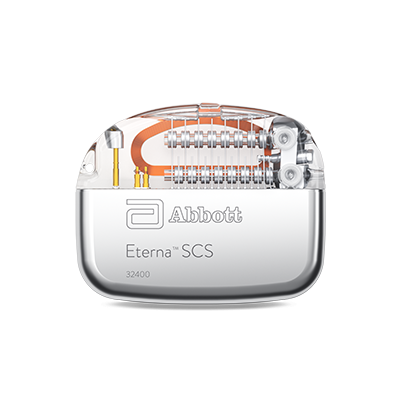
May 12, 2023 — Abbott announced today that the U.S. Food and Drug Administration (FDA) has approved expanded MRI labeling for its Eterna spinal cord stimulation (SCS) system to include new leads that are MR conditional, which means people with chronic pain can undergo MRI scans within the approved outlined conditions and have a wider selection of lead options for full-body scans.1,2 The Eterna SCS system with TotalScan MRI technology now provides full-body MRI capabilities with normal operating mode scanning with select leads.^§1,2
MRI is one of the most widely used technologies to create detailed images of the inside of the body to inform diagnoses and treatment approaches for people with chronic pain.3 People with SCS systems often require MRIs to assess the progression of illnesses such as cancer or multiple sclerosis. In these situations, an MR-conditional system can be invaluable to the patient and radiologist. Recent findings from a study conducted by Abbott have shown that 93% of surgeons consider MRI accessibility an important to essential factor when determining the best SCS system for their patients.4 The study also revealed that surgeons place a high value on the ability to implant leads anywhere in the epidural space, which is between the vertebrae and the spinal cord, while still being able to conduct an MRI scan anywhere on the body.4
"The challenge for those who have implanted devices is the ability to secure efficient and effective scans, as well as treatment options that meet the changing needs of each patient," said Steven Falowski, M.D., Argires Marotti Neurosurgical Associates of Lancaster, Lancaster, Pa. "Abbott’s Eterna SCS system helps address these barriers and concerns with new, as well as previously implanted patients, delivering improved patient care and access."
Restrictions for MRI labeling often pose challenges for doctors when it comes to selecting the right treatment approach for their patients, including the need to have access to a range of MR-conditional leads, which are thin wires that deliver low-energy pulses to the nerves along the spine to disrupt pain. Under the expanded labeling, Abbott’s Eterna SCS system offers:1,2
· Overall faster scan times with half the wait time as compared to commercially available SCS systems with lead placements anywhere along the spine*
· The TriCentrus paddle lead has the widest electrical array that can be scanned in normal operating mode without radiofrequency power restrictions in 1.5T MRI scanners^
· Full-body MRI capabilities with normal operating mode scanning on the TriCentrus paddle lead, improved SAR ratings on the Penta 5-column paddle lead, and MR conditionality to the 90 cm Octrode stimulation lead, enabling higher quality images§
"In the past, label restrictions have made it difficult for physicians and their patients utilizing spinal cord stimulation systems to benefit from diagnostic technology," said Pedro Malha, vice president, neuromodulation, Abbott. "With this label expansion, clinicians can now accelerate the steps required for imaging without compromising safety.”
For more information: www.abbott.com
References:
^Comparison of horizontal electrode array span of surgical paddle leads labeled for 1.5T MRI scanning at normal operating mode.
§As compared to Abbott’s previously approved MR conditional labeling.
*For MRI scans longer than 30 minutes with lead placements in the full spine. The FDA requires radiologists to pause MRIs anywhere from 30 to 60 minutes between scan cycles for patients with implants.
 October 19, 2026