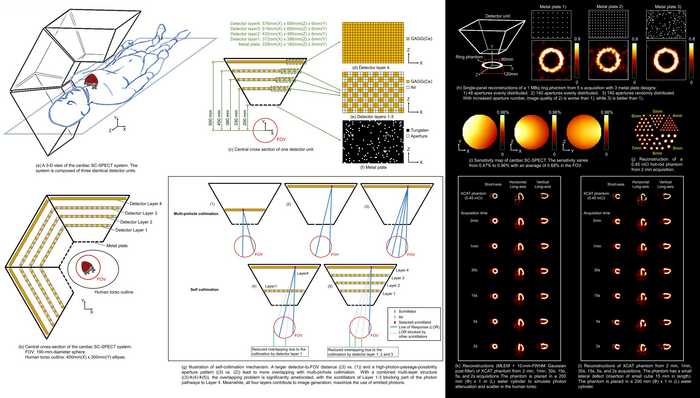
System geometry, imaging mechanism, and performance evaluation of a self-collimating SPECT for fast dynamic cardiac imaging. Image courtesy of Debin Zhang, Xingchun Zheng, Yifan Hu, Zhenlei Lyu, Yaqiang Liu, and Tianyu Ma, Tsinghua University, Beijing, Beijing, China; Zuo-Xiang He, Beijing Tsinghua Changgung Hospital, Tsinghua University, Beijing, Beijing, China; and Rutao Yao, University of Buffalo, State of New York, East Amherst, New York.
June 15, 2022 — A cardiac SPECT imaging system performs scans 10 to 100 times faster than current SPECT systems, according to new research presented at the Society of Nuclear Medicine and Molecular Imaging 2022 Annual Meeting. The advantages of self-collimation SPECT include dramatically shortened scan time, better image quality, increased patient throughput, and reduced radiation exposure to patients.
Heart disease—which includes heart attack, heart failure and arrhythmias—is the leading cause of death among adults in the United States. The Centers for Disease Control and Prevention reports that nearly 660,000 Americans die from heart disease each year, accounting for one out of every four deaths.
The new system is constructed with the concept of self-collimation; active detectors in a multi-layer architecture carry out the dual functionality of detection and collimation. This concept improves the conventional SPECT paradigm, in which a mechanical collimator is the backbone but also the bottleneck of imaging performance.
“SPECT is an important noninvasive imaging tool for the diagnosis and risk stratification of patients with coronary heart disease,” said Debin Zhang, a doctoral student in the Department of Engineering Physics at Tsinghua University in Beijing, China. “However, conventional SPECT suffers from long scan time and poor image quality as a result of relying on a mechanical collimator. The new SPECT system is capable of performing fast-framed dynamic scans with high quality.”
To break away from the constraints of mechanical collimator, the research team designed a self-collimating cardiac SPECT system. They used a multilayer, interspaced mosaic-patterned detector that carries out a dual function of photon detection and collimation. The signal-to-noise ratio of the system is further improved with a random pattern of apertures on the metal plate, which also functions as part of the collimation. The system had an average sensitivity of 0.68 percent in the field of view and was able to identify the defect in a cardiac phantom in as little as 2 seconds.
“The technology proposed in this work may drive a paradigm shift in all single-photon-emission-based molecular imaging and nuclear medicine technologies,” remarked Tianyu Ma, PhD, associate professor of Engineering Physics at Tsinghua University. “The new detector design opens up a broad range of possibilities for development of new imaging systems with better image quality, higher speed, and better diagnostic accuracy in molecular imaging.”
Abstract 250. “Feasibility study of a self-collimating SPECT for fast dynamic cardiac imaging,” Debin Zhang, Xingchun Zheng, Yifan Hu, Zhenlei Lyu, Yaqiang Liu, and Tianyu Ma, Tsinghua University, Beijing, Beijing, China; Zuo-Xiang He, Beijing Tsinghua Changgung Hospital, Tsinghua University, Beijing, Beijing, China; and Rutao Yao, University of Buffalo, State of New York, East Amherst, New York.
For more information: www.snmmi.org
 October 06, 2026