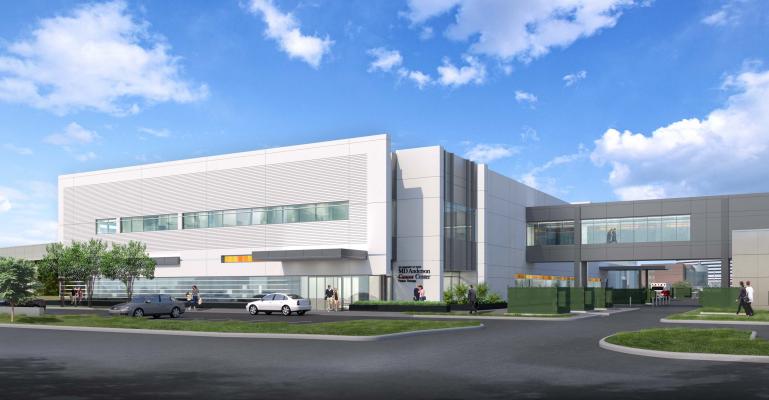
The MD Anderson Proton Therapy Center expansion is expected to be completed in 2023. Rendering courtesy of Stantec.
August 8, 2019 ― The University of Texas MD Anderson Cancer Center unveiled plans to expand its Proton Therapy Center during a groundbreaking ceremony. The expansion will more than double the center’s size to more than 160,000 square feet – almost the size of three football fields – allowing more patients greater access to the most advanced and precise form of radiation therapy.
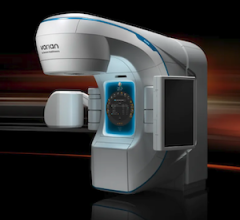
The estimated completion of the new building is November 2023. The $159 million expansion will be led by Gilbane Building Co. and will increase the center size to include a total of eight radiation therapy machines that rotate 360 degrees around a patient to deliver a proton beam to the exact area intended for treatment. The new machines, developed by Hitachi, will deliver intensity-modulated proton therapy (IMPT), the most precise form of image-guided radiation therapy (IGRT) available. The expansion also will include an additional synchrotron, the massive accelerator that creates the proton beam, as well as rooms with improved design for a better patient experience.
“For over a decade, MD Anderson has led the world in the field of proton therapy,” said Peter WT Pisters, M.D., president. “Our physicians and international cancer experts continue to push the boundaries to provide the most innovative care to our patients, and now we are working to provide increased access to that care so even more people can potentially benefit from this important treatment option.”
Proton therapy is an advanced type of radiation treatment that uses a beam of protons to deliver radiation directly to the tumor, destroying cancer cells while sparing healthy tissue. Protons enter the body with a low radiation dose, stop at the tumor, match its shape and volume or depth, and deposit the bulk of their cancer-fighting energy precisely at the tumor.
This therapy currently is used to treat a number of cancers in adult and pediatric patients, including prostate, lung, head and neck, liver, esophagus, brain and lymphoma, a cancer of the lymphatic system.
“This expansion is critical for patients who need access to proton therapy,” said Steven J. Frank, M.D., medical director of the Proton Therapy Center. “Our center has been operating at capacity, treating patients 20 hours a day, five days a week. Doubling our size will mean not only that we can treat more patients, but that we can do so using the very latest technology while achieving remarkable efficiency.”
Since opening in 2006, MD Anderson’s Proton Therapy Center has treated more than 9,300 patients from the United States and across the world within its current 73,500-square-foot facility. In 2018, MD Anderson treated 819 patients with proton therapy, a nearly 11 percent increase from 2017. Currently, 38 percent of patients are treated for head and neck cancers, but the center also sees numerous patients for prostate, lung, liver and brain cancers, as well as a range of pediatric cancers.
“As more patients become eligible for proton therapy, we want to make sure that those who need access to protons have the opportunity to receive them,” said Pisters. “This expansion will aid us in our efforts to provide the most-effective treatment for each patient, based on their specific disease.”
For more information: www.mdanderson.org

 October 13, 2026