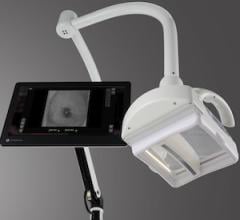
January 30, 2015 — A new breast imaging technique pioneered at Mayo Clinic nearly quadruples detection rates of invasive breast cancers in women with dense breast tissue, according to the results of a major study published in the American Journal of Roentgenology.
Molecular breast imaging (MBI) is a supplemental imaging technology designed to find tumors that would otherwise be obscured by surrounding dense breast tissue on a mammogram. Tumors and dense breast tissue can both appear white on a mammogram, making tumors indistinguishable from background tissue in women with dense breasts. About half of all screening-aged women have dense breast tissue, according to Deborah Rhodes, M.D., a Mayo Clinic Breast Clinic physician and the senior author of this study.
MBI increased the detection rate of invasive breast cancers by more than 360 percent when used in addition to regular screening mammography, according to the study. MBI uses small, semiconductor-based gamma cameras to image the breast following injection of a radiotracer that tumors absorb avidly.
Unlike conventional breast imaging techniques such as mammography and ultrasound, MBI exploits the different behavior of tumors relative to background tissue, producing a functional image of the breast that can detect tumors not seen on mammography.
The study, conducted at Mayo Clinic, included 1,585 women with heterogeneously or extremely dense breasts who underwent an MBI exam at the time of their screening mammogram.
Some of the key findings were:
- Of these women, 21 were diagnosed with cancer — five through mammography alone (24 percent, or 3.2 cancers per 1,000 women) and 19 with mammography plus MBI (91 percent, or 12 cancers per 1,000 women).
- Particularly notable was the fourfold increase in detection of invasive cancers (1.9 invasive cancers per 1,000 women with mammography and 8.8 per 1,000 women with mammography plus MBI). Detection rates for noninvasive cancers were not significantly different.
- The risk of incurring an unnecessary biopsy because of a false positive exam increased in this study, from 1 in 100 women with mammography to 4 in 100 women with mammography plus MBI. (By comparison, recent studies have shown that alternative supplemental screening techniques, such as ultrasound and MRI, generate about eight additional unnecessary biopsies per 100 women.)
“The finding that MBI substantially increases detection rates of invasive cancers in dense breasts without an unacceptably high increase in false positive findings has important implications for breast cancer screening decisions, particularly as 20 states now require mammography facilities to notify women about breast density and encourage discussion of supplemental screening options,” said Rhodes. “These findings suggest that MBI has a more favorable balance of additional invasive cancers detected versus additional biopsies incurred relative to other supplemental screening options.”
“Recent studies have reported supplemental cancer detection rates of 1.9 per 1,000 women screened with automated whole breast ultrasound and 1.2 to 2.8 per 1,000 women screened with digital breast tomosynthesis, so our finding of an additional 8.8 cancers per 1,000 women makes MBI a very compelling option for women who elect supplemental screening,” Rhodes added.
The study was made possible by a grant from the Susan G. Komen Foundation and a Clinical and Translational Science Awards (CTSA) grant from the National Center for Advancing Translational Sciences (NCATS), a component of the National Institutes of Health (NIH).
For more information: www.mayoclinic.org
 October 09, 2026