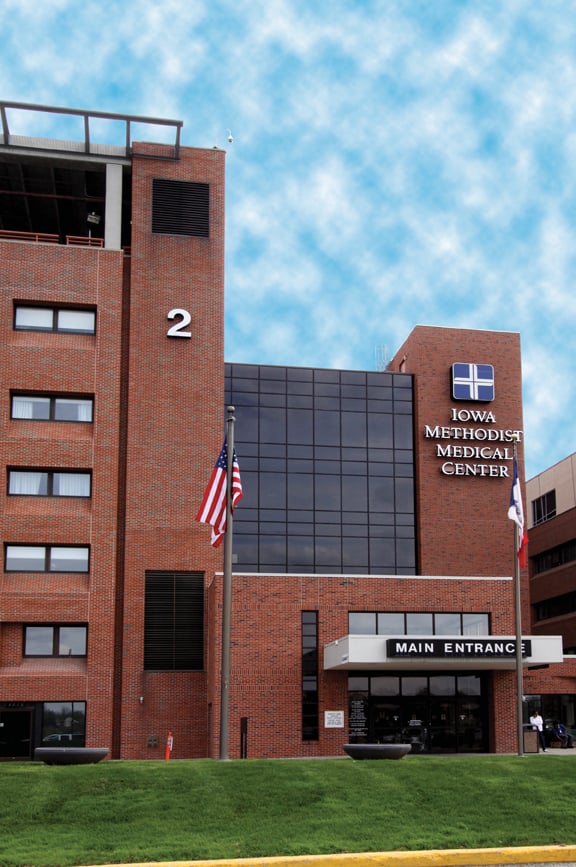
Iowa Methodist Medical Center.
UnityPoint Health, formerly Iowa Healthcare, a multi-city integrated delivery system based in Des Moines, Iowa, recently consolidated and standardized technology in a transformation aimed at empowering primary care physicians to take the lead in care coordination for patients. Todd Holling, assistant director of clinical applications for UnityPoint Health, explains what they are trying to achieve and how healthcare IT is helping them reach their goals.
Q. What is the primary focus for the consolidation of healthcare IT at UnityPoint Health?
A. Our focus is on providing the best outcome for every patient, every time. We’ve tried to infuse that goal into every part of our business — not just the front-line providers, but also the administrative and IT ranks, so that everyone understands what they do makes a difference.
Q. What is the No. 1 priority you have identified to meet this goal?
A. Driving toward more integrated and standardized platforms is our No. 1 priority. This not only includes radiology and cardiology, but extends to other systems in lab, pharmacy, oncology and more. We have a lot of moving pieces, but at the end of the day we’re all trying to do the same things. The more variability we have in our IT platforms, the more costs, complexities and issues we face. We are driving standardization of processes throughout all of our facilities and leveraging a governance structure that enables geographically disparate facilities to share and adopt each other’s best practices.
Q. How will your healthcare IT help you consolidate data to coordinate care?
A. Better coordination of patient care among providers and service lines results in the optimum management of population health. In order to reach this goal, all of the patient’s providers need to be talking together and coming up with the best plan of care for the patient. To achieve this, we need to be able to utilize the information in our systems to empower better clinical decision-making. This means that from an IT perspective, we need to be using patients’ data sets to support comprehensive care and be proactive, with the end goal being less time spent at our facilities.
Q. What part does your healthcare IT partner play in the consolidation of data?
A. Coordination of healthcare technology is critical to meeting patients’ needs and that means writing complex interfaces between ology-specific platforms and our EHR. The more interfaces you have between systems, the more potential there is for problems. Smooth integration between platforms — for instance, our McKesson Radiology (enterprise medical imaging system) communicates easily with our EHR and this aids in minimizing the integration and consolidation complexity. Imaging (radiology and cardiology) plays a critical role in care coordination, including screening and preventive care. We want to see our physicians being able to make appropriate clinical decisions, choose the correct imaging procedures and have the accessibility to have the results at their fingertips — and share them with their patients as well.
Q. What are your healthcare IT goals?
A. Our roadmap for imaging services is structured around supporting the growth in demand and increasing the accessibility of reports. We want to be more virtual with our architecture and lighter in our delivery format, so that people can access imaging data anytime, anywhere without having to download a full client. We are looking to integrate medical imaging into our patient portals, making reports and images more accessible to patients as well. When patients have access to their own imaging, it makes them feel more involved and empowered, and helps them understand what’s going on with their own care. Ultimately, we will be able to deliver images to patients so that they can access them digitally and in real time from their homes.
All of these initiatives point to the critical role of healthcare IT in enabling not just better coordination of care, but better management of health across populations.

 September 09, 2026