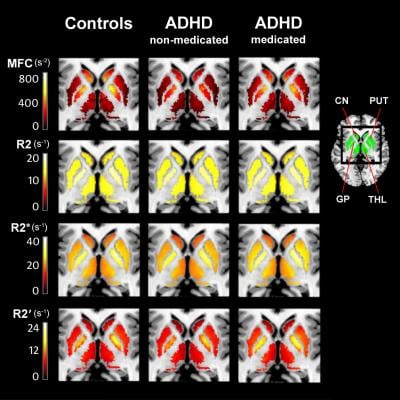
December 2, 2013 — Magnetic resonance imaging (MRI) provides a noninvasive way to measure iron levels in the brains of people with attention deficit hyperactivity disorder (ADHD), according to a study being presented at the Radiological Society of North America Annual Meeting (RSNA 2013). Researchers said the method could help physicians and parents make better-informed decisions about medication.
Psychostimulant medications such as Ritalin are among the drugs commonly used to reduce ADHD symptoms. Psychostimulants affect levels of dopamine, a neurotransmitter in the brain associated with addiction.
"Studies show that psychostimulant drugs increase dopamine levels and help the kids that we suspect have lower dopamine levels," said Vitria Adisetiyo, Ph.D., postdoctoral research fellow, Medical University of South Carolina, Charleston, S.C. "As brain iron is required for dopamine synthesis, assessment of iron levels with MRI may provide a noninvasive, indirect measure of dopamine."
Adisetiyo and colleagues explored this possibility by measuring brain iron in 22 children and adolescents with ADHD and 27 healthy control children and adolescents using an MRI technique called magnetic field correlation (MFC) imaging. The technique is relatively new, having been introduced in 2006 by study co-authors and faculty members Joseph Helpern, Ph.D., and Jens Jensen, Ph.D.
"MRI relaxation rates are the more conventional way to measure brain iron, but they are not very specific," said Adisetiyo. "We added MFC because it offers more refined specificity."
The results showed that the 12 ADHD patients who had never been on medication had significantly lower brain iron than the 10 ADHD patients who had been on psychostimulant medication or the 27 typically developing children and adolescents in the control group. In contrast, no significant group differences were detected using relaxation rates or serum measures. The lower brain iron levels in the non-medicated group appeared to normalize with psychostimulant medication.
MFC imaging's ability to noninvasively detect the low iron levels may help improve ADHD diagnosis and guide optimal treatment. Noninvasive methods are particularly important in a pediatric population, Adisetiyo noted.
"This method enables us to exploit inherent biomarkers in the body and indirectly measure dopamine levels without needing any contrast agent," said Adisetiyo.
If the results can be replicated in larger studies, then MFC might have a future role in determining which patients would benefit from psychostimulants — an important consideration because the drugs can become addictive in some patients and lead to abuse of other psychostimulant drugs like cocaine.
"It would be beneficial, when the psychiatrist is less confident of a diagnosis, if you could put a patient in a scanner for 15 minutes and confirm that brain iron is low," said Adisetiyo. "And we could possibly identify kids with normal iron levels who could potentially become addicts."
Along with replicating the results in a larger population of patients, the researchers hope to expand their studies to look at the relationship between cocaine addiction and brain iron.
Other co-authors are F. Xavier Castellanos, M.D., Adriana Di Martino, M.D., Kevin Gray, M.D., Els Fieremans, Ph.D., Ali Tabesh, Ph.D., and Rachael Deardorff, M.S.
For more information: www.musc.edu, www.rsna.org

 October 08, 2026