December 22, 2011 — Newly developed computer software combined with magnetic resonance imaging (MRI) of a fetus may help physicians better assess a woman's potential for a difficult childbirth. Results of a study using the new software were presented at the annual meeting of the Radiological Society of North America (RSNA).
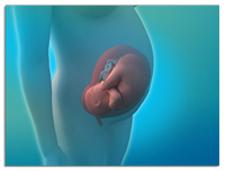
Because a woman's birth canal is curved and not much wider than a fetus's head, a baby must move through the canal in a specific sequence of maneuvers. A failure in the process, such as a head turned the wrong way at the wrong time, can result in dystocia, or difficult labor.
"The mechanics of the human birth canal make for a very complicated delivery process compared to other mammals," said Olivier Ami, M.D., Ph.D., an obstetrician in the department of radiology at Antoine Beclere's Hospital, Université Paris Sud, France. "We now have computer-simulated childbirth to identify potential problems."
Using the new software, called PREDIBIRTH, Ami and a team of researchers processed MR images of 24 pregnant women. The result was a three-dimensional (3-D) reconstruction of both the pelvis and the fetus along with 72 possible trajectories of the baby's head through the birth canal. Based on these simulations, the program scored each mother's likelihood of a normal birth.
"This goes beyond simple imaging," Ami said. "The software simulates the properties of potential deliveries."
For purposes of the study, the PREDIBIRTH scores were computed retrospectively and measured against delivery outcomes for the 24 women. Thirteen women delivered normally. These deliveries were scored as highly favorable by the simulator. Three women who delivered by elective cesarean-section (C-section)—two of which involved babies of excessive weight—were scored at high risk for dystocia.
Of the five women delivered by emergency C-section, two involved heart rhythm abnormalities and were scored mildly favorable and favorable. Three involved obstructed labor, all of whom scored at high risk of dystocia. Three women delivered with vacuum extraction and had mildly favorable simulator scores.
"The results in predicting dystocia were highly accurate," Ami said. "Our simulation predictions seem to be a significant improvement over pelvimetry."
Pelvimetry, which measures the pelvis manually or by imaging to determine its adequacy for childbirth, is commonly used but not entirely reliable, according to Ami.
"A small pelvis may be able to deliver without problems, and a big pelvis might require mechanical help during childbirth," he said. "This uncertainty raises the rate of C-sections."
In the United States, C-sections account for approximately one-third of all births. In France, the rate of mechanical problems is 30 percent, two-thirds of which are emergency procedures.
"An emergency C-section has six to seven times more morbidity and mortality than a planned C-section," Ami said. "With this virtual childbirth software, the majority of C-sections could be planned rather than emergency, and difficult instrumental extractions might disappear in the near future."
Coauthors are Lucie Cassagnes, M.D.; Jean-Francois Uhl, M.D.; Didier Lemery, M.D., Ph.D.; Vincent Delmas; Gérard Mage, M.D., Ph.D.; and Louis Boyer, M.D.
For more information: www.radiologyinfo.org

 October 09, 2026