This article appeared as an introduction to the image-guided radiotherapy (IGRT) comparison chart in the October 2010 issue of Imaging Technology News.
Of the many ongoing efforts to minimize dose to healthy tissue and target radiation to hit only tumors, image-guided radiotherapy (IGRT) is one of those at the forefront. New features and software are being offered and updated by major systems vendors, as IGRT is being used to help treat cancers throughout the body.
It has always been a challenge for radiation oncologists to achieve tumor location that is 100 percent precise, either because of patient shifts in position, tumor movement due to body functions like respiration, or tumor changes during the treatment series. IGRT helps to overcome these challenges, in some cases even providing tumor localization in real-time, spanning the fourth dimension.
This year has seen a number of developments and improvements in IGRT systems, including the following:
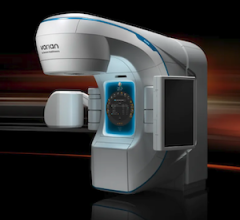
- Exhibited for the first time at this year’s American Association of Physicists in Medicine (AAPM) show, the TrueBeam IGRT and radiosurgery system synchronizes imaging, patient positioning, motion management and treatment delivery. The system delivers dose more than twice as fast as other linear accelerators, Varian says.
There currently are two cancer centers worldwide using the TrueBeam system. One is the University of Zurich, which began using it clinically in March to treat prostate, lung cancer, brain and spinal metastases and benign nerve sheath tumors. There also are plans to extend treatments for lung and upper gastrointestinal tract cancers, along with palliative treatments.
- Resonant Medical, a company recently acquired by Elekta, has IGRT systems for soft tissues like breast and prostate, using 3-D ultrasound technology. It compares 3-D structures, not images, to provide accurate guidance noninvasively, without additional dose or any compromise to throughput. The Clarity System is FDA-cleared and compatible with many models of linear accelerators and computed tomography (CT) scanners.
- The Artiste Solution from Siemens is a linear accelerator with a portfolio of image-guided delivery tools, so that a clinician can choose the optimal IGRT application for the preferred treatment approach. These include 3-D megavoltage cone beam imaging and in-room CT.
In addition, Siemens recently entered into an agreement with Calypso Medical Technologies to sell the Calypso system in Europe. Calypso’s GPS for the Body is a real-time localization technology; when the tumor moves outside of the field of radiation, therapy can be stopped while the patient is repositioned to ensure that the tumor, not the surrounding healthy tissue, receives the radiation dose.
- Another real-time patient positioning tool is the ExacTrac infrared monitoring device, which tracks the patient’s position throughout treatment delivery. The ceiling-mounted device from Brainlab is available as an add-on to existing treatment machines. ExacTrac offers high-resolution stereoscopic X-ray imaging to target tumors and correct patient positioning.
- The Protura robotic positioning system can integrate with an existing IGRT solution and linear accelerator to provide an all-in-one motion management solution. From Civco Medical Solutions, Protura has a built-in redundant sensor system that is used for auto-calibration and assures the robot precisely aligns the patient without needing an external camera system.
- Some IGRT systems involve the use of fiducials for tracking tumors and positioning patients for treatment. FlexiMarc and FlexiCoil, used primarly for IGRT, are the first implanted fiducials designed with image projection and marker stability as the primary objectives. Node-based technology projects a nonbiological image, providing a reference for accurate localization. Both the human eye and software programs can identify FlexiMarc and FlexiCoil.
Research Takes a Stock Market Approach
In an interesting approach to tracking tumors, one new model is being developed employing tactics similar to those used by stock market analysts to estimate the rise and fall of stocks. Dan Ruan, Ph.D., an instructor in radiation oncology at Stanford University, presented her approach during the recent AAPM meeting.
With a typical IGRT protocol, X-rays are used at fixed frequency to validate the location of the tumor target. This rate may be increased to improve the localization accuracy. Ruan’s model, however, which she calls adaptive, aims to accurately localize tumors in real-time by imaging smarter, rather than more frequently. It makes online decisions as to whether or not it is necessary to take a new X-ray image during treatment. She presented test cases where imaging frequency was reduced by 40 to 50 percent without sacrificing tumor localization accuracy.1
Reference:
1. D. Ruan, “Reducing Imaging Dose without Sacrificing Target Localization Accuracy: A Feasibility Study.” Research supported by the National Cancer Institute and AAPM Seed Funding Initiative.

 October 23, 2026