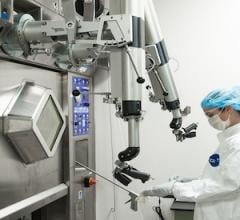

January 21, 2010 - Staging the cancer, whether it has metastasized to the lymph nodes, is an important prognostic indicator that determines the course of therapy. A widely accepted technique used during surgery to stage breast, melanoma, and other cancers involves the injection of a radiopharmaceutical near the tumor, which results in its accumulation in the local lymph nodes.
Surgeons use a gamma probe to identify those specific lymph nodes to drain the tumor. These sentinel nodes are excised by the surgeon and analyzed by the pathologist for the presence of cancer.
New wireless gamma and PET probes locate the sentinel lymph nodes or cancerous tissues that accumulate the radiopharmaceuticals. The new Node Seeker 900 wireless system includes wireless operation for convenience, a touchscreen control unit for ease-of-use, IV pole-mountable for portability, and an on-board isotope for fast quality control checks. IntraMedical Imaging (IMI) recently introduced these FDA-cleared system.
For more information: www.gammaprobe.com

 October 30, 2026