

Greg Freiherr has reported on developments in radiology since 1983. He runs the consulting service, The Freiherr Group.
Blog | March 13, 2013
Woe is PET/MR
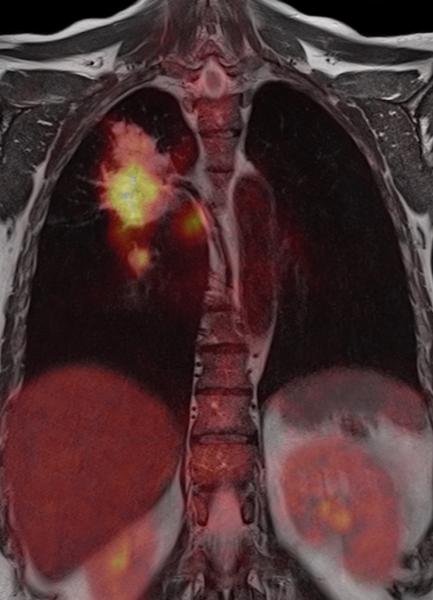
PET/MR: better together or apart? Image courtesy of Siemens, provided by University of Geneva
What a difference a few decades makes. In the early-1980s radiologists couldn’t wait to get their hands on an MR scanner. Never mind the clinical value was anything but certain. The most anybody could say is that MR absolutely, positively diagnosed multiple sclerosis. Reimbursement, shmeimbursement. Lay down a couple or three million dollars. Knock down a wall. Bring that monster in. We’ll just hope it pans out.
Not so today. PET/MR has been on the market since late-2011, FDA cleared and CE marked. At the European Congress of Radiology (ECR) March 7, Prof. Heinz-Peter Schlemmer, M.D., head of the radiology department and coordinator of the imaging and radio-oncology research program at the German Cancer Research Centre in Heidelberg, Germany, asked whether PET/MR was “a marriage made in heaven or hell?” It was a rhetorical question.
Schlemmer threw advocates a bone, explaining their initial euphoria as “understandable,” then slamming them upside the head, saying PET/MR “cannot enter routine clinical practice before diagnostic accuracy, influence on therapeutic management and economic factors have been carefully considered and evidenced by clinical studies.”
Never mind that his argument doesn’t make much sense…he may be right. In today’s global economy, novel technologies are a hard sell.
By Schlemmer’s account, PET/MR is a day late and a dollar short. Coming more than a decade after PET/CT, it would appear to have missed the boat, albeit not for lack of trying. The unique challenge of cohabitating a PET ring and superconducting magnets was why the first PET/MR images took until 2006 to make. This excludes the images fused from separately performed scans, of course. And therein may be the saving grace of PET/MR.
A good case can be made for the purchase of a hybrid. It merges data from simultaneously performed MR and PET scans, yet has the potential to conduct MR separately. Vendors leveraged the two faces of PET/CT in the early days, when demand for hybrid scans was only beginning. PET/MR can deliver about the same diagnostic information as its CT counterpart. Some believe it can do even more.
Consider oncology. MR is the go-to modality when assessing cancer. Oncology applications account for 90 percent of PET/CT. And the coming wave of biomarkers, led by Eli Lilly’s Amyvid for visualizing amyloid plaques suggestive of Alzheimer’s Disease, will be focusing more and more PET attention on the brain, another strength of MR.
Schlemmer admitted as much in his cautionary tale at the ECR. MR provides superior anatomical resolution to CT, he noted, with PET providing metabolic and membrane receptor information. “Together (PET/MR) increases your sensitivity and specificity for tumor detection and characterization,” he said.
Yet Schlemmer felt compelled to warn against putting too much stock in the hybrid’s chances, saying it remains to be seen if the simultaneous acquisition of MR and PET will deliver better accuracy than “subsequent sequencing.” I have to ask…why should we care?
Schlemmer’s argument can be turned on its head. Why not gather those data simultaneously rather than separately? Sure, you have to buy the hybrid, but you can run it in MR mode, if demand for PET/MR is not available. Reimbursement shouldn’t be an issue. MR and PET are each reimbursable.
Most astonishing is that pessimism about PET/MR should come from Europe. If there is one place on earth that should be throwing its radiological arms around PET/MR, it is Europe. Concerns about X-ray dose in the United States were first voiced on the other side of the Atlantic. MR is free from ionizing radiation.
You’d think support for PET/MR would be bubbling over there.
Related Content

News | FDA
Oct.7, 2026 – MRI2CT Inc. has received FDA 510(k) clearance for NextMR, its AI powered imaging platform, for generating ...
 October 07, 2026

News | Information Technology
October 6, 2026 – Clearsense has introduced a cloud-based medical image archive designed to reduce the cost of ...
October 07, 2026 
Oct. 5, 2026 — GE HealthCare has announced a definitive agreement to acquire SOFIE Biosciences, a U.S.-based CMO for PET ...
October 06, 2026 
News | PET-MRI
Sept. 29, 2026 —Yale New Haven Hospital has installed a state-of-the-art positron emission tomography/magnetic resonance ...
October 05, 2026 
Aug. 30, 2026 — Bayer has announced the presentation of first detailed results from the Phase III REVEAL study, an ...
September 02, 2026 
News | Radiology Imaging
Aug. 13, 2026 — Epic's new Care Everywhere Diagnostic Image Exchange allows health systems using Epic to share ...
August 21, 2026 
News | Cardiac Imaging
Aug. 20, 2026 – The novel, radiopaque, polymer-based embolic coil from Embolization, Inc. has now surpassed 125 implants ...
August 20, 2026 
News | Radiology Business
Aug. 4, 2026 — Canon Medical Systems USA (CMSU) has appointed Tsuneo "Neo" Imai as president and chief executive officer ...
August 10, 2026 
News | Radiology Imaging
Aug. 4, 2026 — A new study from the Harvey L. Neiman Health Policy Institute found that the time between an imaging scan ...
August 06, 2026 
News | Contrast Agents
Aug. 5, 2026 — Bracco Group is bringing a newly authorized macrocyclic gadolinium-based contrast agent (GBCA) for ...
August 05, 2026 © Copyright Wainscot Media. All Rights Reserved.

Subscribe Now