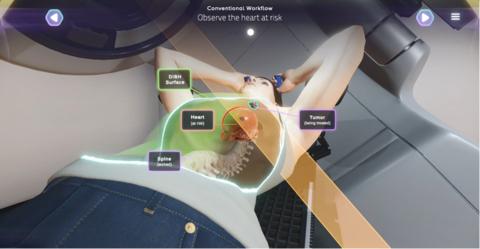
With Brainlab ExacTrac Dynamic® Deep Inspiration Breath Hold module, clinicians are able to correlate internal and external anatomy, revealing any misalignment that may otherwise remain undetected. (Source: Brainlab)
August 15, 2022 — Brainlab announced the first group of breast cancer patients treated in United States with the ExacTrac Dynamic Deep Inspiration Breath Hold (DIBH) module. Highlands Oncology is the first to treat and has already treated 19 patients in the first two weeks. By combining highly accurate surface guided technology with triggered X-ray imaging, Highlands Oncology clinicians have been able to address challenges that often necessitated large treatment margins, due to the lack of available technology and integration.
Breast cancer is the most prevalent cancer for women in the United States and second most deadly cancer for females according to the US government and breast cancer advocacy groups. While strides have been made in numerous therapies and survival has continued to improve, one key area has remained a challenge for doctors treating breast cancer: reducing late cardiac toxicity in their patients. In the ongoing pursuit of curative radiation treatment, clinicians find that they may undesirably irradiate the heart while attempting to eradicate breast cancer for left-sided cancer patients, as unmanaged breathing may bring the vital organ into the radiation targeting field. ExacTrac Dynamic and its novel tracking technology actively monitors breathing with correlation to internal anatomy checks. New research out of Brussels demonstrates that application of this technology helps reduce cardiac toxicity and the possibility of lung cancer for patients in certain risk groups including those with high blood pressure, high cholesterol and obesity, but also critically, for those with persistent smoking habits.
Until now, patients receiving breast cancer radiation treatments have been typically treated using large treatment margins and without the benefit of internal anatomical verification during treatment. By incorporating ‘on-the-fly’ X-Ray confirmation, Brainlab technology streamlines the process and delivers confidence that the heart is outside of the treatment beam. This solution delivers correlation between internal and external anatomy in one shot, revealing any misalignment that may otherwise remain undetected.
“The clinical community has been waiting for a solution like this,” said Hershey H. Garner, JD, MD, Chief of Radiation Oncology at Highlands Oncology. “For physicians, we often have the dilemma of shielding healthy tissue and organs at the expense of more aggressive cancer destruction. With ExacTrac Dynamic and DIBH, we can now mitigate the risk to the heart with minimal trade off. We can now track a surrogate and image internal anatomy—since Brainlab technology can do both simultaneously. We have trusted Brainlab for our most precise cranial setups and our team was impressed how easy it was to implement DIBH 'out of the box' technology for our breast cancer patients.”
“With this new technology, we knew the potential for increased clinician and patient interest would be high,” said Sean Clark, President, Brainlab Inc. “Our customers are very excited about adding this technology to their armamentarium of cancer-fighting technology. Helping wider patient populations with co-morbidities achieve better cancer outcomes aligns perfectly with our mission to increase access to and consistency of treatment.”
For more information: www.brainlab.com

 March 06, 2026